

India currently has over 240 operational SEZs spread across the country, hosting thousands of
businesses ranging from small export units to massive global enterprise operations. These zones
offer a compelling combination of benefits that go well beyond simple tax breaks. Companies
operating within SEZs benefit from 100% income tax exemption for the first five years, a 50%
exemption for the following five years, and continued partial exemptions thereafter. They also benefit
from duty-free import of capital goods, streamlined customs procedures, single-window clearance for
regulatory approvals, and significantly reduced compliance burden compared to operating outside the
zone.

When a company sets up inside an SEZ, it is operating within a clearly defined regulatory framework
with established rules, consistent enforcement, and a dedicated administrative body that exists
specifically to support business operations. This predictability is enormously valuable for enterprises
that have been burned by regulatory uncertainty in other markets.
The geographic spread of India’s SEZs is also a significant factor in GCC acceleration. Zones are no
longer concentrated only in the major metros. Tier 2 cities like Kochi, Jaipur, Nagpur, Coimbatore, and
Ahmedabad now have operational SEZs that are attracting GCC investments from enterprises looking
to access talent at lower cost points while still benefiting from the regulatory and infrastructure
advantages of the SEZ framework.
AI and automation are reshaping what SEZ-based GCCs actually do. The early generation of SEZ
operations was dominated by IT services, BPO, and basic back-office functions. The current generation
is running machine learning pipelines, predictive analytics platforms, and AI governance frameworks
that feed directly into global enterprise decision-making.
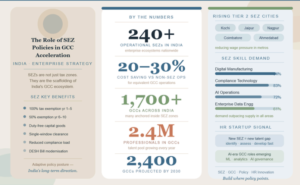
Digital manufacturing, compliance technology, AI operations, and enterprise data engineering are
among the skill areas most commonly required in newly activated SEZ-based GCCs, and the gap
between demand and available supply in these areas is consistently wide. HR startups that can build
tools to identify, assess, and develop talent for SEZ-based GCC environments are operating in one of
the most commercially promising segments of the enterprise HR market.
India’s SEZ policy framework is not static. The government has been actively reviewing and refining the
framework through initiatives like the Development of Enterprise and Service Hubs (DESH) Bill, which
aims to modernise the SEZ structure to better accommodate domestic-facing GCC operations
alongside export-oriented businesses.
This legislative evolution signals that policymakers understand the changing nature of GCC work and
are willing to adapt the regulatory framework to support it. For enterprises and HR leaders planning
their India strategy, that adaptive policy posture is one of the most reassuring signals available —
because it suggests that India’s commitment to being a world-class GCC destination is not just a
current moment opportunity. It is a long-term strategic direction.