
For decades, the first month at a new job was defined by administrative friction:
completing stacks of HR compliance forms, waiting weeks for IT system provisioning,
sitting through generic multi-day presentation decks, and reading outdated internal wikis.
For university graduates entering the corporate workforce, B2B HR tech founders, and
enterprise leadership teams, this static onboarding process introduced immediate
friction. In an economy where autonomous agents and high-density talent pods drive
business outcomes, spending 30 days simply “learning where things are” is an
unacceptable operational drag. Modern enterprise onboarding has shifted from a passive
administrative checklist into an AI-driven, hyper-personalized acceleration engine.
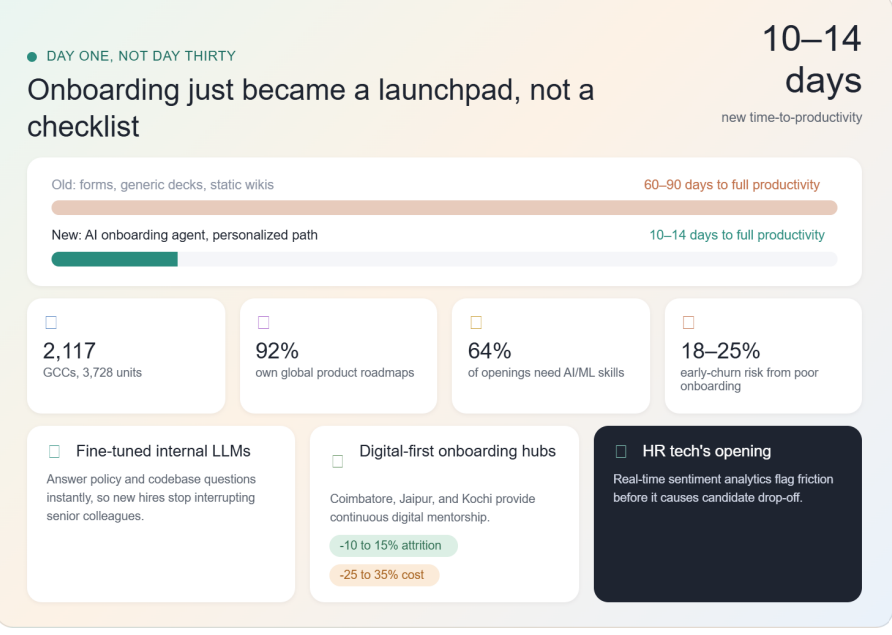
This transformation is reshaping macro GCC trends across India. The national landscape
encompasses 2,117 active GCCs operating across 3,728 distinct units, forming a $98.4
billion economic sector that employs over 2.36 million skilled professionals. Crucially,
with 92% of capability centers owning global product roadmaps and strategic process
mandates, organizations cannot afford slow employee ramp-up times. Traditional
onboarding pipelines required 60 to 90 days for a new hire to reach full productivity. By
integrating intelligent onboarding architectures, leading GCCs are compressing time-toproductivity down to 10 to 14 days, enabling new hires to contribute to active code
repositories and strategic deliverables during their very first month.

The primary technical catalyst driving this shift is the application of AI and automation
across employee integration workflows. Instead of assigning static reading materials,
enterprise HR systems deploy role-specific AI onboarding agents. These agents analyze a
new hire’s existing skills, compare them against team architecture requirements, and
instantly generate a personalized 30-day learning path. Rather than interrupting senior
colleagues with basic policy or codebase questions, new employees interact with finetuned internal LLMs that answer queries instantly while enforcing security protocols. With
64% of all new GCC job openings mandating advanced AI or machine learning
capabilities, new hires use these same intelligent tools on day one to understand legacy
codebases and run automated unit tests.
Re-architecting the first month at work reflects progressive future-of-work thinking that
transforms overall enterprise talent strategy. The first 30 days are critical for long-term
retention; studies show that disorganized onboarding accelerates early-stage voluntary
churn, which lingers between 18% and 25% across tech corridors. To build structured
onboarding ecosystems without incurring extreme overhead in primary hubs like
Bengaluru and Hyderabad, global firms are leveraging regional spokes in secondary hubs
like Coimbatore, Jaipur, and Kochi. Establishing digital-first onboarding hubs in these
centers allows GCCs to achieve 10% to 15% lower voluntary attrition rates while securing
25% to 35% in overall operational cost savings, creating stable environments where new
hires receive continuous digital mentorship.
This onboarding overhaul creates a major growth vector for HR innovation, accelerating
enterprise adoption for agile B2B HR startups. Traditional HR management systems built
for static record-keeping fail to deliver dynamic, adaptive onboarding experiences. High-
growth HR tech startups developing AI-driven onboarding orchestrators, automated
compliance verification tools, intelligent mentor-matching algorithms, and real-time
sentiment analytics are achieving rapid enterprise integration. Modern platforms
empower HR leaders to track new-hire engagement in real time, automatically identifying
learning bottlenecks and helping managers intervene before friction leads to candidate
drop-off.