

Many global enterprises operating in India still rely on
legacy recruitment pipelines characterized by multi-stage interview loops, delayed
feedback cycles, and prolonged approval chains. For university graduates seeking their
first career moves, B2B HR tech founders, and executive boardrooms, the true price of a
sluggish recruitment process extends far beyond administrative overhead. In 2026, a slow
hiring process imposes severe financial, cultural, and strategic costs that directly threaten
an organization’s competitive edge.
This operational drag is particularly visible across macro GCC trends across India. The
national landscape now encompasses 2,117 active GCCs operating across 3,728 distinct
units, representing a $98.4 billion economic sector that employs over 2.36 million skilled
professionals. Crucially, with nearly 96% of centers established since 2021 launched with
direct product and portfolio mandates, Indian capability hubs are accountable for global
product roadmaps. When a critical engineering or leadership seat remains vacant for 60
to 90 days, project delivery schedules slip, product releases are delayed, and parent
organizations risk losing market share to agile competitors

The primary force amplifying the cost of slow hiring is the rapid integration of AI and
automation across business infrastructure. With 64% of all new GCC job openings
mandating advanced AI or machine learning capabilities, the market faces an acute
53% talent deficit in specialized AI roles. Data indicates that top-tier AI candidates receive
multiple competing offers within 10 to 14 days of entering the job market. Prolonged hiring
timelines result in severe candidate drop-off, forcing organizations to settle for secondary
candidate pools or restart recruitment cycles from scratch.
Relying on outdated recruitment velocity directly undermines progressive future-of-work
thinking and weakens overall enterprise talent strategy. Beyond missed hiring
opportunities, a slow recruitment process inflicts severe internal damage on existing
teams. When vacancies remain unfilled for months, existing employees absorb the extra
workload, leading to heightened burnout, reduced engagement, and voluntary tech churn
that lingers between 18% and 25%. Furthermore, a prolonged, fragmented candidate
experience damages a company’s employer brand, signaling to top graduates and
experienced professionals that the organization operates with bureaucratic inefficiency.
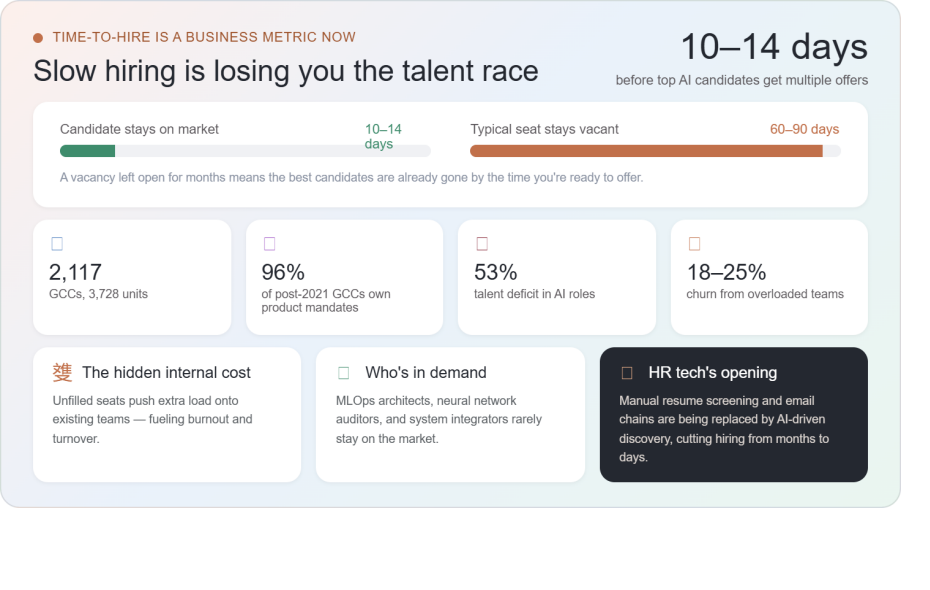
This recruitment bottleneck creates an extraordinary market opportunity for HR
innovation, accelerating enterprise adoption for agile B2B HR startups. Traditional
applicant tracking systems that rely on manual resume screening and slow email chains
are being replaced by intelligent recruitment platforms. High-growth HR tech startups
developing AI-driven candidate discovery engines, automated skill-sandbox
assessments, real-time compensation benchmarking tools, and predictive candidate
drop-off analytics are achieving rapid enterprise integration. Modern platforms empower
talent acquisition leaders to shorten hiring cycles from months down to days, bringing
data-backed precision to talent acquisition.