

The global business landscape is changing rapidly, and the evolution from traditional IT/ITeS services
to next-generation Global Capability Centers (GCCs) is becoming one of the most important shifts in
the corporate world. For many years, India was known mainly for IT outsourcing and back-office
support services. Today, however, companies are transforming their India operations into strategic
innovation hubs that drive product development, AI solutions, advanced analytics, cybersecurity, and
digital transformation.
One of the biggest GCC trends is the move away from purely cost-driven outsourcing models toward
value-driven innovation ecosystems. Earlier, IT/ITeS centers mainly focused on customer support,
software maintenance, data processing, and operational tasks. Next-generation GCCs, on the other
hand, are deeply involved in areas like artificial intelligence, cloud engineering, product innovation,
cybersecurity, automation, and advanced research.

The role of AI + automation is one of the key differences between traditional IT/ITeS models and nextgen GCCs. Automation tools, machine learning, and generative AI are transforming how businesses
operate, reducing dependency on repetitive manual work and increasing demand for high-value digital
skills. Studies suggest that 40–50% of repetitive IT and operational tasks can now be automated,
leading to 20–30% gains in productivity and efficiency.
Traditional IT jobs focused heavily on coding, testing, and support functions, but today companies are
looking for professionals who can combine technical expertise with business understanding, creativity,
and analytical thinking. Roles such as AI engineers, cloud architects, cybersecurity analysts,
automation consultants, and digital product managers are becoming increasingly important.
Companies are increasingly using AI-powered recruitment platforms to identify candidates with niche
digital and analytical skills. Digital learning ecosystems and certification-based upskilling programs are
helping employees transition into future-ready roles. HR teams are focusing on employee experience,
hybrid work models, mental well-being, and innovation-led employer branding to attract top talent in a
highly competitive market.
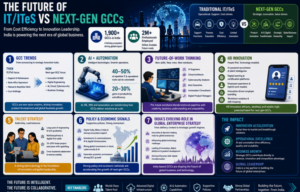
Multinational companies are increasingly setting up innovation and decision-making
centers in cities like Bengaluru, Hyderabad, Pune, Chennai, and Gurugram. These centers are no
longer just delivery hubs; they are becoming strategic growth engines that influence global technology
roadmaps and business strategies. From leading AI innovation to managing enterprise-wide digital
platforms, India-based GCCs are helping shape the future of global business operations.
In conclusion, the future of IT/ITeS is closely connected to the rise of next-generation GCCs. While
traditional outsourcing models focused on operational efficiency, modern GCCs are driving innovation,
digital transformation, and business strategy at a global level. With strong AI-powered capabilities,
evolving talent strategies, supportive policy frameworks, and access to world-class technical talent,
India is becoming a global leader in next-gen GCC transformation.