

Building a GCC is one kind of challenge. Scaling one past a thousand people is a completely
different problem — and the organisations that conflate the two tend to find themselves in
serious difficulty somewhere around the five-hundred-person mark. The economics of a
small, focused captive centre are relatively straightforward. The economics of a large-scale
GCC operation are complex, interconnected, and surprisingly easy to get wrong even when
the underlying talent and strategy are sound.

The average fully loaded cost per
employee in a large-scale GCC in Bangalore or Hyderabad — including salary, benefits, real
estate, technology infrastructure, and management overhead — runs between ₹25 to ₹45
lakhs per year depending on the seniority mix. Multiply that across a thousand or more
people and the annual operating cost of a single GCC can run to ₹300 to ₹500 crore or more.
At that scale, a one percent improvement in attrition or a five percent gain in productivity is
worth crores — which is why the economics of talent management at large GCCs are
genuinely strategic rather than merely operational.
The cost of replacing a mid-level professional — accounting for recruitment fees, productivity
loss during vacancy, onboarding time, and the institutional knowledge that walks out the door
— is typically estimated at six to twelve months of that person’s annual salary. In a large GCC
running at industry-average attrition rates of 18 to 22 percent annually, the annual cost of
attrition on a thousand-person team can easily exceed ₹50 to ₹80 crore.
AI and automation are reshaping the economics of scale in ways that create both savings and
new cost categories simultaneously. On the savings side, AI tools are enabling productivity
gains in software engineering, data analytics, customer research, and documentation that
allow GCCs to do more with the same headcount
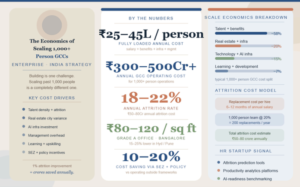
Real estate and infrastructure represent another significant variable in the large-scale GCC
economics equation. Grade A commercial office space in Bangalore costs between ₹80 to
₹120 per square foot per month, while equivalent space in Hyderabad or Pune runs
approximately 15 to 25 percent lower. For a thousand-person operation requiring roughly
150,000 to 200,000 square feet of space, the real estate cost differential between cities can
amount to ₹15 to ₹30 crore annually. This is why city selection for large GCC operations is not
just a talent decision — it is an economic one, and the two need to be evaluated together
rather than sequentially.
For HR startups and workforce technology platforms, the economics of large-scale GCCs
represent a clear product mandate. The organisations managing thousand-plus person
operations need attrition prediction tools, workforce productivity analytics, compensation
benchmarking platforms, and AI-readiness assessment frameworks that are calibrated to the
specific economic realities of large GCC environments. Generic HR tools designed for smaller
organisations or for Western markets will not serve this need.