

The structure of Global Capability Centers is changing rapidly as artificial intelligence becomes
central to enterprise operations. Traditional GCC organization charts were designed around
functions such as IT support, finance operations, HR services, and customer support. Today,
however, many global companies are shifting toward an “AI-first” GCC org chart, where artificial
intelligence and data-driven decision-making sit at the core of how teams are structured.
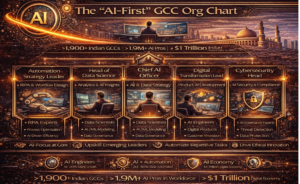
The country currently hosts 1,900+ GCCs employing
more than 1.9 million professionals, making it one of the largest global hubs for enterprise
technology operations. Earlier, these centers focused on cost efficiency and operational scale.
Now, they are becoming innovation engines where AI engineering, automation strategy,
cybersecurity, analytics, and digital product development are led from India.
These leaders work together to ensure that AI is embedded across every function of the
organization. Instead of operating in silos, teams collaborate through shared data platforms and
automation frameworks. Research suggests that organizations that adopt AI-driven operating
models can improve productivity by 20–30%, making the shift not just strategic but
economically valuable.
Roles such as AI trainers, data governance specialists, automation architects, and AI ethics
advisors are emerging as critical positions in the new org chart. Studies suggest that nearly 44%
of core workplace skills will change by 2027, highlighting the urgency of preparing talent for AIpowered environments.
AI-driven recruitment platforms, predictive workforce analytics, and internal skill marketplaces
are becoming essential tools. Many organizations are using automation within HR functions
themselves to streamline onboarding, payroll, compliance documentation, and employee
engagement analysis.
Talent strategy in an AI-first GCC must prioritize continuous learning. India produces more than
1.5 million engineering graduates every year, offering enterprises access to a large and growing
technical talent pool. However, companies must invest in structured upskilling programs in areas
such as AI, cloud computing, cybersecurity, and data analytics.
India’s evolving role in global enterprise strategy is central to this transformation. Many
multinational companies are assigning global AI development, automation strategy, and digital
product innovation to their Indian GCCs. This reflects growing confidence in India’s talent
ecosystem and technology leadership.
In conclusion, the AI-first GCC org chart represents a fundamental shift in how modern
organizations structure their workforce. It places artificial intelligence, data, and automation at the
heart of enterprise operations while empowering people to focus on strategic thinking, creativity,
and innovation.