

Where global
companies once relied on India as an abundant source of entry-level technical support, the market has
rapidly pivoted toward high-value specialization, product ownership, and strategic leadership. India
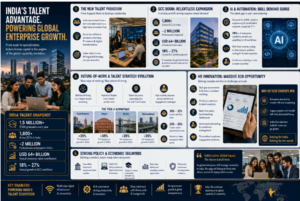
produces over 1.5 million STEM graduates annually, creating one of the largest talent reservoirs in
the world.However, the real story lies in how this workforce is being re-skilled and deployed. For fresh
graduates entering this fast-moving market and HR startups developing modern talent platforms,
understanding these emerging supply dynamics is critical to navigating the future of global work.
A major factor shaping today’s hiring landscape is the relentless expansion driven by Global
Capability Center (GCC) trends. India currently hosts over 1,800 active GCCs, employing nearly 2
million skilled professionals and contributing over USD 64 billion in annual economic value.The
overall GCC workforce is growing at an aggressive 18% to 27% annually, far outpacing traditional IT
services growth.This exponential demand has created a tight talent supply for specialized roles.

While overall graduate
numbers are massive, the demand for specialized talent in machine learning, platform engineering, and
generative AI outpaces immediate market supply by more than 3 to 1.With over 78% of enterprise
capability centers actively upskilling their workforce for AI workflows, the profile of the ideal
candidate has changed dramatically. Companies now prioritize data literacy, problem-solving, and
domain-specific knowledge over routine coding abilities. For graduates, this means that foundational
technical training must be paired with continuous learning to remain competitive in an AI-augmented
workspace.
To adapt to these shifts, modern enterprises are adopting forward-looking future-of-work thinking to
reshape their core talent strategy. High talent mobility and an average metro attrition rate of 18% to
22% mean that traditional volume hiring and rigid 9-to-5 models are no longer effective. Organizations
are shifting toward skill-based hiring, flexible hybrid arrangements, and talent discovery in Tier-2 and
Tier-3 cities. Cities like Coimbatore, Jaipur, Kochi, and Ahmedabad are seeing 35% year-over-year
headcount growth in capability centers, offering companies access to untapped talent pools with
10% to 12% lower attrition rates and 25% to 35% lower talent operational costs.
Legacy recruitment software is poorly equipped to handle skill-first talent matching or predictive retention modeling across
distributed locations. HR tech startups that build automated skill-gap assessments, AI-driven candidate
verification, real-time salary benchmarking dashboards, and personalized employee engagement tools
are finding an eager client base among multinational talent acquisition leaders. Solving talent
bottlenecks in India’s high-density market creates scalable solutions that can be applied globally.
Underpinned by strong policy and economic signals, India’s talent ecosystem continues to
strengthen its international edge. State-level skilling incentives, national digital infrastructure initiatives,
and rapid urban growth ensure that the talent pipeline remains resilient. As global headquarters
delegate greater decision-making authority and advanced technical ownership to local teams, India’s
evolving role in global enterprise strategy is firmly locked in.