

Global Capability Centers (GCCs) have evolved significantly over the past decade, moving far beyond
traditional support operations to become strategic hubs for innovation, analytics, and business
transformation. Today, companies across industries such as banking, healthcare, telecom,
manufacturing, retail, and technology are using GCCs to manage critical business functions and drive
digital growth.
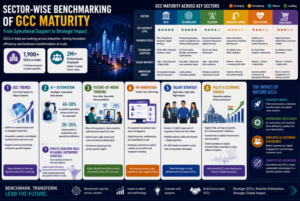
Today, mature GCCs are leading advanced functions like AI
engineering, cloud transformation, cybersecurity, product development, and predictive analytics.
Sectors such as BFSI, technology, and telecom are currently among the most mature GCC ecosystems
because of their early investments in digital transformation and analytics-driven operations. Industries
like manufacturing, logistics, and healthcare are rapidly catching up by adopting smart technologies
and automation at scale.

Organizations are increasingly using AI-powered recruitment platforms and workforce analytics tools to
identify and retain top talent. Mature GCCs are investing heavily in digital learning platforms,
leadership development programs, and employee experience initiatives to stay competitive. HR teams
are also focusing on data-driven workforce planning and skill mapping to prepare employees for future
business demands.
Mature
GCCs are focusing not only on technology adoption but also on creating agile, innovation-driven work
cultures. Companies are redesigning workforce models to support hybrid work, cross-functional
collaboration, and continuous learning. New-age roles such as AI engineers, cybersecurity analysts,
cloud architects, automation specialists, and digital product managers are becoming central across
sectors.
GCCs apply predictive maintenance and smart factory systems. Studies suggest that 40–50% of
repetitive business operations across sectors can be automated, resulting in 20–35% improvements
in productivity and operational efficiency. Mature GCCs are
increasingly focusing on multidisciplinary capabilities rather than just technical expertise. Companies
investing in structured upskilling programs, certifications, and leadership development often achieve
20–30% faster innovation cycles and stronger operational performance.
AI ecosystems, startup innovation, manufacturing growth, and data governance are strengthening
India’s position as a global GCC destination. Sectors such as fintech, healthcare technology,
renewable energy, and semiconductor engineering are receiving increased investments globally, which
is accelerating the need for mature innovation-led GCCs. At the same time, enterprises worldwide are
increasing spending on cloud computing, cybersecurity, AI, and digital transformation, creating strong
momentum for advanced GCC operations.
In conclusion, sector-wise benchmarking of GCC maturity highlights how industries are evolving at
different speeds toward innovation-led and technology-driven operations. The most mature GCCs are
those that successfully combine AI-powered capabilities, strong talent strategies, innovation-focused
leadership, and agile workforce models. For B2B leaders and HR startups, the opportunity lies in
helping organizations accelerate their maturity journey through better workforce solutions, digital
transformation frameworks, and talent innovation strategies. As industries continue to evolve, India’s
GCC ecosystem will remain a major driver of global business transformation and enterprise growth.