

When global enterprises evaluate India as a GCC destination, talent is always the first
conversation. And the foundation of that talent conversation is India’s higher education
system — one of the largest and most complex in the world. Understanding what that system
produces, where it excels, where it falls short, and how it is evolving is essential for anyone
building a serious workforce strategy around India’s GCC opportunity. The higher education
ecosystem is not just a pipeline. It is the bedrock on which the entire GCC growth story either
stands or struggles.
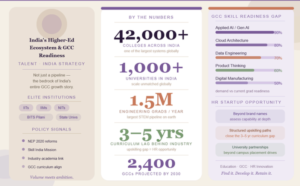
India’s higher education system is staggering in scale. The country has over 1,000 universities
and more than 42,000 colleges, making it one of the largest higher education systems on the
planet. It produces over 1.5 million engineering graduates annually, along with hundreds of
thousands of graduates in management, sciences, law, and the humanities. The sheer volume
of talent entering the workforce every year is one of the primary reasons global boards feel
confident making long-term bets on India
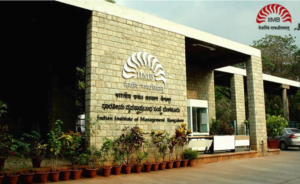
Quality, however, is more nuanced than volume. India’s top-tier institutions — the IITs, IIMs,
NITs, and BITS Pilani — produce graduates who compete comfortably with the best in the
world. Companies like Google, Microsoft, McKinsey, and Goldman Sachs recruit aggressively
from these campuses, and the professionals who come out of them are genuinely worldclass. The challenge is that these elite institutions represent a small fraction of the total
graduate output.
This is precisely where the future-of-work thinking becomes relevant. The skills that GCCs
need most urgently today — applied AI, data engineering, cloud architecture, product
thinking, and digital manufacturing — are not yet being taught comprehensively across the
broad university system. The curriculum in many institutions lags industry by three to five
years, which means graduates arrive technically capable in foundational areas but needing
significant upskilling before they can contribute meaningfully to the kind of work modern
GCCs are doing.
AI and automation are also reshaping what GCC readiness actually means. The ability to work
alongside AI tools, interpret machine-generated outputs, and contribute to AI-driven
workflows is rapidly becoming a baseline expectation rather than a specialist skill. India’s
younger graduates are growing up digitally native, and their adaptability to new tools is
genuinely impressive.
The enterprises building GCCs here need partners who can help them look beyond
institutional brand names, assess capability at depth, design structured onboarding and
upskilling journeys, and build relationships with universities that go beyond campus
placement drives. India’s graduate talent is abundant, ambitious, and increasingly capable.
The organisations that build the infrastructure to find it, develop it, and retain it will define
what India’s GCC story looks like by 2030.