

India’s Global Capability Centers (GCCs) have officially outgrown their original identity as back-office
execution units. As the nation’s ecosystem scales across 2,117 active GCCs generating $98.4 billion
in annual revenue and employing over 2.36 million professionals, the sector has become a central
driver of the national economy.With over 90% of these hubs operating as multi-functional
innovation centers owning global product roadmaps, parent organizations no longer view India purely
as a delivery footprint. However, this rapid elevation has exposed a critical operational bottleneck: a
severe leadership gap at the top.
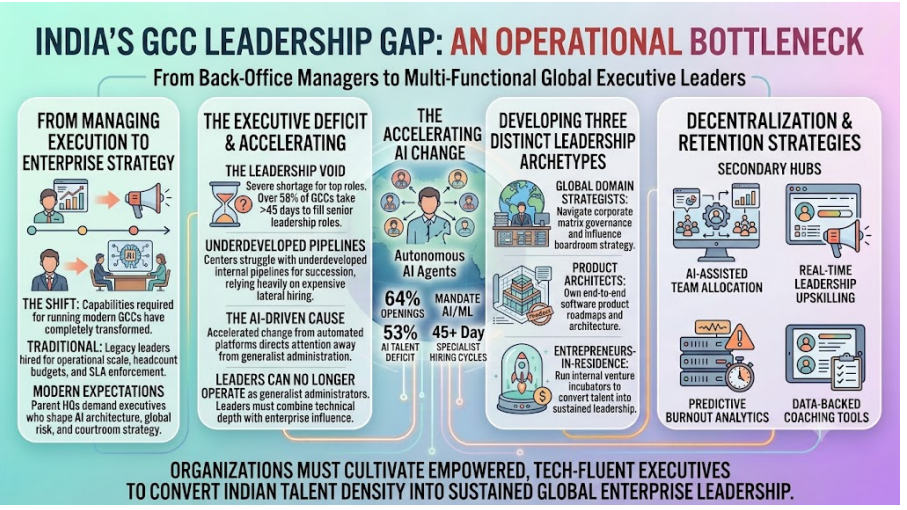
The fundamental cause of this shortage is that the capabilities required to run a modern capability hub
have completely shifted.Traditional GCC leaders were hired to manage operational scale, control
headcount budgets, and enforce service level agreements.Today, parent headquarters demand
executives who can shape enterprise AI architecture, manage global risk, and influence boardroom
strategy.Yet, over 58% of GCCs report taking longer than 45 days to fill senior leadership roles,
relying heavily on expensive lateral hiring because internal succession pipelines remain
underdeveloped. Caught between accelerating technical change and legacy management habits,
many centers struggle to find executives who combine technical depth with enterprise influence.

This leadership transformation is being driven by the rapid adoption of AI and automation across
corporate infrastructure. As automated platforms handle standard operational supervision, senior
executives must transition from managing human capacity to directing intelligent digital systems.With
64% of all new GCC job openings mandating advanced AI or machine learning capabilities
and the market navigating a 53% talent deficit in specialized AI roles, leaders can no longer
operate as generalist administrators.They must possess the technical domain expertise needed to
evaluate complex AI deployments, protect corporate intellectual property, and build high-density
engineering teams.
Addressing this executive deficit requires progressive future-of-work thinking to rebuild enterprise
talent strategy. Organizations are abandoning top-down management structures, focusing instead on
developing three distinct leadership archetypes. To retain these high-impact executives and prevent voluntary
turnover—which lingers between 18% and 25% across primary tech corridors—enterprises are
decentralizing operations into secondary hubs like Coimbatore, Jaipur, and Kochi. Expanding into
regional spokes allows GCCs to achieve 10% to 15% lower voluntary attrition rates while securing
25% to 35% in operational cost savings, creating stable environments for multi-year strategic
initiatives.
This executive talent bottleneck presents an extraordinary growth vector for HR innovation, driving
rapid market adoption for agile B2B HR startups. Legacy executive search agencies that rely on
informal networking fail to evaluate a candidate’s real-time AI orchestration capabilities or strategic
influence. High-growth HR tech startups developing AI-powered executive assessment sandboxes,
real-time leadership capability graphs, predictive succession planning engines, and cross-border
compensation benchmarking tools are seeing rapid enterprise integration. Modern platforms empower
talent acquisition leaders to identify potential leaders early, shortening senior recruitment cycles from
months down to weeks