

Talent is the reason global enterprises want to be in India. Infrastructure is the
reason they can actually operate here at the level of sophistication their global standards
demand. The relationship between infrastructure investment and GCC expansion is not
incidental. It is causal. Every significant improvement in India’s physical, digital, and
institutional infrastructure directly expands the addressable geography for GCC investment
and raises the ceiling on what those centres can credibly do.
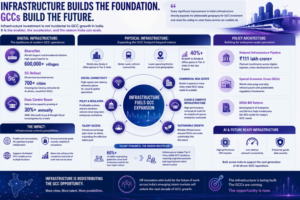
The digital infrastructure story is the most immediately relevant for modern GCC operations.
India’s BharatNet programme — the world’s largest rural broadband connectivity initiative —
has extended high-speed internet access to over 600,000 villages, fundamentally changing
the connectivity map of the country. The national 5G rollout, which has covered over 700
cities since its launch, is creating the low-latency network environment that AI-driven, cloudfirst GCC operations depend on.

Data centre capacity in India has been growing at over 30 percent annually, with major global
cloud providers including AWS, Microsoft Azure, and Google Cloud all making significant
investments in Indian data centre infrastructure. For a GCC running real-time analytics,
machine learning pipelines, or global collaboration platforms, these infrastructure
improvements are not background noise — they are the enabling conditions for the work
itself.
The National Infrastructure Pipeline, which involves planned investments of over ₹111 lakh
crore across sectors including digital infrastructure, logistics, and urban development, is
creating the conditions for enterprise-grade operations in locations that global companies
would not have seriously considered even recently. Special Economic Zones continue to offer
world-class plug-and-play infrastructure within predictable regulatory frameworks, and the
evolution toward Development of Enterprise and Service Hubs under the DESH Bill is
modernising that model for the current generation of GCC requirements.
AI and automation requirements are also shaping infrastructure investment priorities in ways
that are directly relevant to GCC expansion. The compute infrastructure required to run
serious AI workloads — high-performance GPU clusters, low-latency network connectivity,
and enterprise-grade data security frameworks — is being built out across India at an
accelerating pace. Enterprises establishing AI-focused GCC operations need to know that the
infrastructure backbone they depend on will scale with their ambitions, and India’s
investment trajectory is increasingly giving them confidence that it will.
For HR startups and workforce innovators, the infrastructure expansion story matters
because it determines where the next wave of GCC talent demand will emerge. The
organisations that build hiring, assessment, and development tools calibrated to Tier-2 city
talent markets — rather than assuming all GCC activity will remain concentrated in the
established hubs — will be positioned to serve a much larger addressable market. India’s
infrastructure investment is not just enabling GCC expansion. It is redistributing it
geographically in ways that create new talent markets, new workforce challenges, and new
commercial opportunities for the HR innovators paying close enough attention to no