

Global Research and Development (R&D) hubs in India are rapidly transforming the way multinational
companies innovate and scale their operations. Over the last decade, India has evolved from being
primarily an outsourcing destination to becoming a global center for innovation, engineering, and
product development. Companies across industries such as technology, healthcare, automotive,
telecom, aerospace, and manufacturing are expanding their R&D Global Capability Centers (GCCs) in
India to access skilled talent, advanced digital capabilities, and cost-efficient innovation ecosystems.
One of the biggest GCC trends in the R&D space is the shift from operational support to strategic
innovation leadership. Earlier, many GCCs mainly handled maintenance, testing, and process support
activities. Today, they are deeply involved in advanced research, new product development, AI
engineering, semiconductor design, cloud technologies, and digital transformation initiatives.

As innovation becomes more technology-driven, organizations are looking for professionals who can
combine technical expertise with creativity, analytical thinking, and business understanding. Roles such
as AI researchers, cloud architects, data scientists, semiconductor engineers, and digital product
specialists are seeing high demand. For graduates, this creates exciting opportunities to work on global
innovation projects, but it also highlights the importance of continuous learning and multidisciplinary
skills.
Companies are investing heavily in digital learning platforms, certification programs, and virtual training
ecosystems to continuously upskill employees in emerging technologies. HR teams are also focusing
on flexible work models, innovation-driven employer branding, and employee experience strategies to
attract and retain top talent. For HR startups, this creates a major opportunity to provide solutions in
talent intelligence, workforce analytics, skill mapping, and niche hiring for R&D roles.
India produces one of the world’s largest pools of STEM graduates every year, giving enterprises
access to scalable technical talent. However, companies are now looking for professionals who can
combine domain expertise with digital capabilities and innovation-focused thinking. Organizations that
invest in structured learning and leadership development programs often achieve 20–25% faster
innovation cycles and higher productivity levels.
Programs like “Digital India,” “Make in India,” and increased investments in advanced technology
infrastructure are encouraging multinational companies to expand their R&D presence in the country. At
the same time, global spending on research, AI, and advanced technologies is expected to grow
significantly over the next decade, creating strong demand for scalable innovation capabilities.
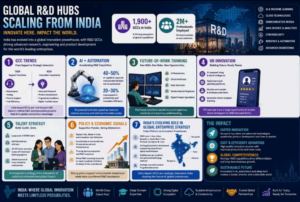
Multinational companies are increasingly setting up or expanding innovation hubs in cities like
Bengaluru, Hyderabad, Pune, Chennai, and Gurugram to leverage India’s technical expertise and
digital ecosystem. From developing next-generation software products to managing advanced
engineering research, India-based GCCs are shaping the future of global innovation.
In conclusion, the scaling of global R&D hubs from India reflects a larger shift toward innovation-led
and technology-driven business growth. With strong AI-powered capabilities, evolving talent
strategies, supportive policy initiatives, and access to world-class technical talent, India is becoming
a global leader in R&D transformation. As enterprises continue to prioritize research and innovation,
India’s GCC ecosystem will remain at the center of global R&D growth and technological advancement.