

India has become the driving force behind this transformation. The country is now home to over
1,700 GCCs, employing approximately 2.4 million professionals across industries such as
technology, healthcare, banking, manufacturing, retail, and engineering. These centres are no
longer focused only on operational excellence. They are leading global projects, developing digital
products, managing enterprise platforms, and creating business strategies that directly impact
international markets. Many multinational companies now trust their India-based GCCs with
responsibilities that were once handled only at global headquarters.
One of the biggest GCC trends is the movement from execution to ownership. Companies are
giving their India teams greater decision-making authority because they recognise the depth of
talent available in the country. Engineers, data scientists, finance professionals, product
managers, and cybersecurity experts are not just delivering projects—they are designing
solutions that shape global business outcomes. This shift reflects a broader change in enterprise
thinking, where capability is valued more than geography.

Artificial intelligence and automation are making GCCs even more valuable. Routine and repetitive
tasks are increasingly being automated, allowing professionals to focus on higher-value work such
as strategic planning, innovation, customer experience, and complex decision-making. Instead of
replacing talent, AI is enhancing human capabilities. Many GCCs are now leading enterprise-wide
AI initiatives, developing machine learning models, building automation platforms, and
strengthening cybersecurity systems.
This transformation also requires a new approach to talent strategy. As GCCs move closer to the
centre of enterprise strategy, companies need professionals with more than technical expertise.
Leadership, problem-solving, cross-functional collaboration, digital skills, and adaptability are
becoming essential qualities. HR leaders must rethink how they recruit, develop, and retain talent
in this new environment. Continuous learning, leadership development, internal mobility, and
skills-based hiring will become increasingly important as organisations compete for highly
specialised professionals.
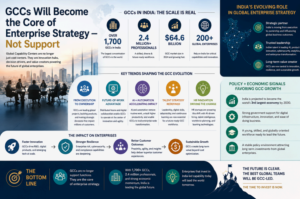
The role of GCCs within multinational organisations will continue to expand over the next decade.
Instead of being viewed as separate operational centres, they will become fully integrated into
enterprise leadership, innovation, risk management, customer experience, and business growth.
Decisions about products, technology, sustainability, digital transformation, and future
investments will increasingly involve GCC leaders working alongside global executives. This
reflects a fundamental shift in how modern enterprises are organised.
GCCs are no longer simply reducing costs—they are creating value, accelerating innovation, and
strengthening enterprise resilience. With over 1,700 GCCs, 2.4 million skilled professionals,
rapidly growing AI capabilities, and a business ecosystem supported by strong economic
momentum, India is becoming one of the world’s most important strategic centres for global
business. For HR startups, this represents an opportunity to build the technologies, talent
strategies, and workforce solutions that will define the next generation of enterprise success.