

As global
enterprise leaders shift away from legacy outsourcing models to set up high-value capability
hubs across India, candidate selection has become a two-way street. Professionals no longer
evaluate potential employers purely on initial compensation packages. Instead, they seek
authentic workplace cultures, meaningful career progression, and direct ownership of global
products. For fresh graduates choosing their first career steps and HR startups building
modern talent platforms, establishing a strong employer brand has become the defining factor
in winning top-tier talent.
The urgency surrounding employer branding is directly fueled by rapid Global Capability
Center (GCC) trends. India currently hosts over 2,100 active GCCs generating nearly USD
98.4 billion in annual economic value and employing over 2.36 million skilled
professionals. Because over 90% of modern GCCs operate as multi-functional innovation
hubs owning core cloud architectures, clinical trial platforms, and global risk management
systems, they are competing directly with venture-funded scale-ups and global tech giants for
the same specialized engineers.

With over 78% of enterprise capability centers actively mandating AI
development and integrating generative automation into daily workflows, engineers want to
know they will be working with cutting-edge tech stacks. A strong employer brand clearly
communicates that an organization invests in state-of-the-art tools, offers continuous
upskilling pathways, and encourages experimentation. For ambitious graduates, choosing an
enterprise with a vocal digital-first brand ensures that their technical skills remain relevant in
an increasingly AI-driven global economy.
To retain top performers, progressive organizations are weaving modern future-of-work
thinking into their broader talent strategy. Today’s top talent prioritizes psychological safety,
flexible hybrid work arrangements, transparent leadership, and clear global mobility paths.
High-growth enterprises are replacing top-down corporate announcements with employee-led
storytelling, highlighting real stories of internal promotion, mentorship, and cross-border
project leadership. Companies that successfully communicate these cultural attributes achieve
up to 28% lower candidate acquisition costs and experience significantly reduced offer
drop-out rates in hyper-competitive hiring corridors.
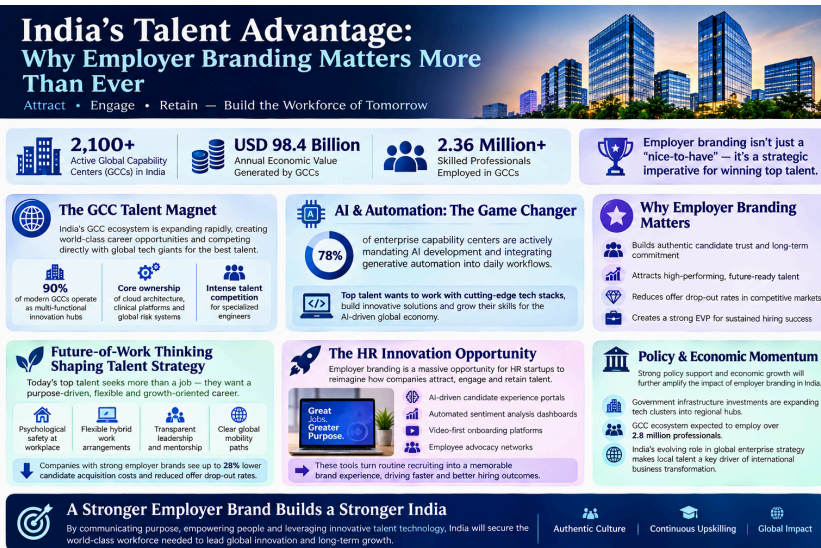
Legacy recruitment tools
focused solely on resume intake are ill-equipped to convey company culture or measure
candidate sentiment during the hiring process. HR tech founders who build AI-driven
candidate experience portals, automated sentiment analysis dashboards, video-first
onboarding platforms, and employee advocacy networks are seeing rapid enterprise
adoption. These tools allow talent acquisition teams to showcase workplace culture at every
touchpoint, turning routine recruiting into a memorable brand experience.
Underpinned by strong policy and economic signals, the business case for employer
branding will only grow stronger. As government infrastructure investments expand tech
clusters into regional hubs and the GCC ecosystem heads toward employing over 2.8 million
professionals, companies cannot afford to rely on brand name recognition alone. India’s
evolving role in global enterprise strategy means that local teams are now driving
international business transformation.