

One of the biggest reasons GCCs are moving toward profit creation is their growing ownership of
high-value business functions. Modern GCCs are no longer waiting for headquarters to assign
tasks. Many now own complete product lifecycles, manage digital platforms, develop enterprise
software, build AI-powered solutions, and lead global engineering initiatives. When a GCC
develops a successful digital product, improves customer retention through advanced analytics,
or launches new technology that increases business revenue, it directly contributes to enterprise
profitability.
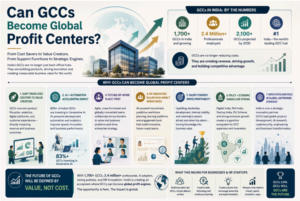
Reports indicate that over 83% of India’s GCCs are investing in Generative AI, integrating AIassisted software development, intelligent automation, predictive analytics, and machine learning
into everyday operations. These technologies enable teams to deliver products faster, improve
operational efficiency, personalise customer experiences, and make better business decisions
using real-time data. Rather than simply reducing operational costs, AI is helping GCCs generate
measurable business value by improving speed, innovation, and revenue potential.

Organisations are moving away from traditional hierarchical structures and embracing agile,
cross-functional, and globally connected teams. GCC professionals now collaborate directly with
business leaders, customers, and innovation teams across multiple regions. This shift requires
employees who are adaptable, digitally skilled, and capable of solving business challenges
beyond their technical expertise. As work becomes more project-based and outcome-focused,
GCCs are becoming integral to enterprise strategy rather than isolated operational units.
Building a profit-generating GCC requires more than hiring technical experts. Organisations need
strong leadership pipelines, continuous learning programmes, AI-powered recruitment, predictive
workforce planning, and employee engagement strategies that support innovation. HR startups
have a significant opportunity to develop platforms that measure workforce productivity, identify
future skills, improve internal mobility, and strengthen organisational culture.
Employees increasingly value career development, meaningful work, flexible work environments,
and opportunities to work on global projects. Organisations that invest in upskilling, leadership
development, AI capabilities, and cross-functional collaboration are better positioned to retain
high-performing professionals. Since knowledge and innovation are becoming key business
assets, talent has emerged as one of the strongest drivers of enterprise profitability.
 T
T
oday, multinational organisations trust their India-based teams to lead global product
development, cybersecurity operations, AI research, engineering excellence, financial
transformation, and customer experience initiatives. Many senior business leaders now view India
as a strategic innovation partner rather than simply a delivery location. This shift reflects the
maturity of India’s talent ecosystem and the growing confidence enterprises have in the country’s
ability to generate business value at a global scale.
The future of GCCs will not be defined by how much money they save but by how much value
they create. With 1,700+ GCCs, 2.4 million skilled professionals, widespread AI adoption,
continuous HR innovation, forward-looking talent strategies, and strong government support,
India is creating an ecosystem where GCCs can become powerful drivers of revenue, innovation,
and competitive advantage. For HR startups, enterprise leaders, and multinational companies, this
represents a major opportunity.