

Multinational companies no longer view these centers as expense line items; instead, they are
evaluated as central intellectual property hubs, core risk mitigators, and key drivers of long-term
enterprise valuation. Favorable policy and economic signals, including modernized safe
harbour tax frameworks and progressive trade treaties, have accelerated this shift. The global
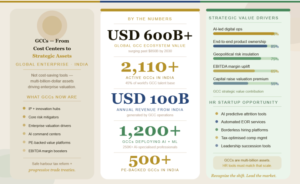
GCC ecosystem is currently valued at over USD 600 billion, with projections forecasting a surge
past USD 850 billion by 2030.
India sits at the center of this structural economic migration, evolving from a delivery engine into
the primary nerve center for global enterprise strategy. The country currently anchors over 2,110
active GCCs, accounting for over 45% of the world’s GCC talent base and generating roughly
USD 100 billion in annual revenue.

Private equity firms and Fortune 500 corporations increasingly treat these centers as repeatable
value-creation platforms, with over 500 PE-backed GCCs currently operational across India. By
establishing end-to-end product ownership and advanced R&D hubs in locations ranging from
established tech capitals to Tier-II emerging cities, multinational firms secure direct control over
critical technology architectures and enterprise governance.
GCCs are no longer merely maintaining existing software; they are building
autonomous digital operating systems that power global businesses. Currently, over 1,200 GCCs
in India deploy advanced AI and machine learning models, leveraging dedicated Centres of
Excellence powered by more than 250,000 AI-specialized professionals. By using generative AI
for predictive risk modeling, real-time supply chain analytics, and automated decision
engines, GCCs insulate parent companies against geopolitical volatility and operational shocks,
converting functional units into intelligent command centers.
GCCs are moving away from rigid,
legacy organizational hierarchies in favor of agile, cross-functional squads equipped with deep
tech capabilities. To retain elite talent in a competitive marketplace, centers offer direct
ownership over global platform roadmaps, clear leadership trajectories, and flexible working
arrangements.
Managing multi-billion-dollar GCC assets demands modern
workforce management tools that go far beyond legacy administrative software. Enterprise
leaders urgently require next-generation solutions, including automated Employer of Record
(EOR) services, AI-powered predictive attrition analytics, borderless hiring platforms, and
tax-optimized global compensation management.
HR startups that deliver specialized
platforms for talent acquisition, leadership succession, and cross-border compliance will
become indispensable growth enablers for global enterprises expanding their capability
footprint.
As global markets face continuous disruption, treating Global Capability Centers as standalone
cost-saving tools is an outdated practice.Enterprise executives, investors, and HR innovators who
recognize this fundamental shift today will lead the market tomorrow, building resilient global
organizations engineered to thrive in an unpredictable future