

Agility has become one of the most overused words in corporate strategy. Every organisation
claims to be agile, every transformation programme promises to deliver agility, and yet the
evidence suggests that most large global enterprises struggle enormously to move quickly when
it matters most. The interesting question is whether GCCs — which have historically been
associated with cost efficiency rather than speed — are actually changing this dynamic.
The traditional view of GCCs placed them at the slow end of the enterprise agility spectrum.
Large offshore operations, significant coordination overhead, time zone challenges, and a culture
of process adherence rather than experimentation — these characteristics made the classic GCC
model more reliable than responsive. What has changed is the nature of GCC work itself. As
India’s centres have moved from transactional processing toward AI development, product
engineering, and strategic analytics, the teams inside them have developed the technical depth
and contextual understanding needed to move quickly on complex problems.

Over 83 percent of India-based GCCs are investing in Generative AI, and the impact on operational speed is
measurable. AI-assisted code generation, automated testing pipelines, intelligent document
processing, and machine learning-driven decision support are all compressing the time it takes
for GCC teams to move from problem identification to deployed solution. The enterprises that
are leading on GCC agility are the ones that have combined genuine mandate ownership with
serious AI investment — creating an environment where India-based teams can identify
problems, design solutions, and ship at speeds that were simply not achievable in the pre-AI GCC
era.
The cross-pollination of
talent between India’s startup ecosystem and its GCC landscape — which flows consistently in
both directions — is introducing a startup mindset into GCC environments that historically valued
process over pace. Professionals who have worked in high-growth startups where shipping fast
and learning faster was the operating model are bringing that orientation into GCC teams, and
the cultural shift is measurable. The challenge is that this culture change requires deliberate
investment in psychological safety, tolerance for intelligent failure, and performance
frameworks that reward learning velocity rather than just output volume.
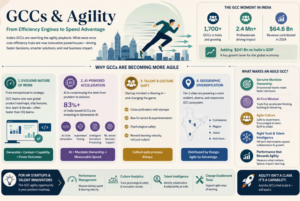
The geographic diversification of India’s GCC footprint is creating another dimension of agility
that is often overlooked. As GCC operations expand into Tier-2 cities like Coimbatore, Nagpur,
and Jaipur, enterprises are building more distributed capability networks that are less vulnerable
to the talent concentration risks of the major metros. Distributed teams, when managed well with
the right collaboration infrastructure, can actually respond faster to market changes than
centralised ones — because they draw on a more diverse set of perspectives and are less
susceptible to the groupthink that large concentrated teams can develop over time.
For HR startups and talent strategy leaders, the GCC agility question is a direct product brief.
Enterprises building more agile GCC operations need performance management tools that
measure delivery speed and learning velocity, culture analytics platforms that can track
psychological safety and innovation climate, and talent intelligence systems that can
identify the cross-functional collaboration capabilities that agile teams depend on. Agility is
not a characteristic that organisations can simply declare. It has to be built — through the right
people, the right culture, and the right tools.