

avigate operating systems, manage
spreadsheets, and write professional emails. Today, as generative models and
autonomous agents integrate directly into enterprise architectures, AI fluency has
emerged as the baseline requirement for modern corporate survival. For recent university
graduates and business leaders alike, AI fluency extends far beyond writing basic
prompts or asking a chatbot to rephrase a memo. It requires understanding how
intelligent software processes data, recognizing systemic model bias, validating machine
outputs, and managing automated agents across daily workflows.
This transition from optional tech skill to core competency is deeply connected to the
rapid expansion of Global Capability Center (GCC) trends across India. The nation
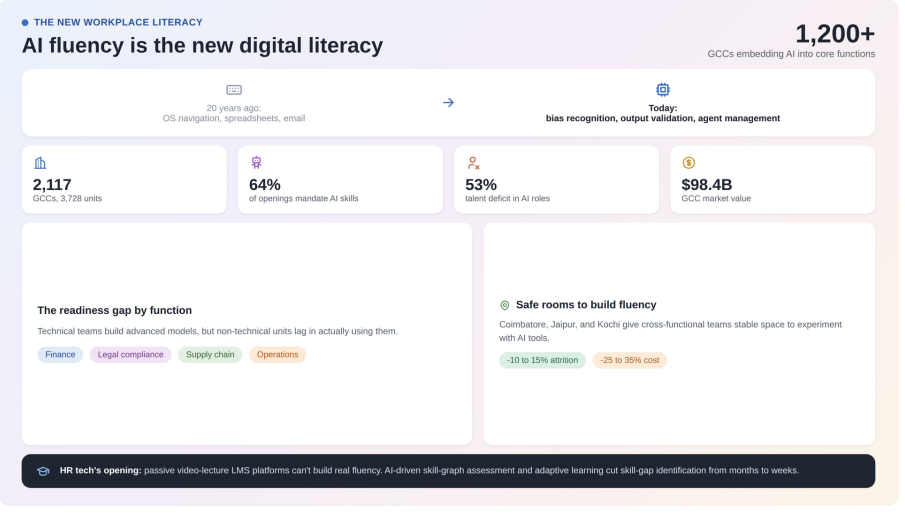
currently hosts 2,117 active GCCs operating across 3,728 distinct units, representing a
massive $98.4 billion market that employs over 2.36 million skilled professionals.
Crucially, more than 1,200 of these capability centers actively embed AI and machine
learning into their core functions. AI-fluent talent is
essential for centers delivering high-stakes international mandates.
The rapid deployment of AI and automation across business infrastructure highlights an
urgent training challenge. Data indicates that 64% of all new GCC job openings explicitly
mandate advanced AI or intelligent automation skills. However, the ecosystem faces an
acute 53% talent deficit in specialized AI roles, keeping voluntary tech churn high at 18%
to 25%. While technical teams build complex algorithmic models, non-technical business
units—spanning corporate finance, legal compliance, supply chain, and operations—often
struggle to integrate AI tools effectively. This operational gap creates a dual reality where
advanced software capabilities exist, but organizational readiness lags behind.
Addressing this gap requires progressive future-of-work thinking to reshape enterprise
talent strategy. Forward-looking organizations are abandoning one-off training seminars
in favor of continuous, hands-on learning frameworks. To build AI-fluent talent pools
without competing in hyper-saturated Tier-1 metros, global firms are expanding into
emerging secondary tech hubs like Coimbatore, Jaipur, and Kochi. Establishing
operations in these regional centers allows enterprises to achieve 10% to 15% lower
attrition rates and secure 25% to 35% in overall operational cost savings, creating stable
environments where cross-functional teams can safely experiment with and master
automated tools.
This widespread need for continuous upskilling creates a major market opportunity for HR
innovation, accelerating demand for agile B2B HR startups. Legacy learning
management platforms that rely on passive video lectures fail to build true operational AI
fluency. High-growth HR tech startups developing AI-driven skill-graph assessment
engines, adaptive learning portals, contribution-based portfolio mapping, and real-time
competency analytics are seeing rapid enterprise adoption. Modern recruitment and
upskilling platforms empower talent acquisition and learning teams to cut skill-gap
identification timelines from months down to weeks, bringing data-backed precision to
workforce transformation.