

There is a reason global enterprises keep choosing India when they decide to build their most
important capability centres. It is not just the talent. It is not just the cost advantage. It is the
fact that India has built a policy environment that makes it genuinely easier, safer, and more
rewarding to invest here than almost anywhere else in the world. For HR leaders, workforce
strategists, and startup founders operating in the GCC space, understanding India’s policy
framework is not a background detail. It is central to understanding why the opportunity
ahead is as large as it is.

India’s GCC story has been building for over two decades, but the policy momentum behind it
has accelerated dramatically in recent years. The country currently hosts over 1,700 GCCs
employing nearly 2.4 million professionals, and projections point to 2,400 GCCs by 2030.
That growth does not happen by accident. It happens because successive Indian
governments have made deliberate, consistent choices to create conditions that attract
global enterprise investment
The Special Economic Zones Act has been one of the foundational pillars of this story.For a global enterprise evaluating
where to place a critical capability centre, the ability to operate within a well-governed SEZ —
with predictable rules, reliable power, and connectivity infrastructure — removes a significant
layer of operational risk. India has over 240 operational SEZs spread across the country,
many of which have become thriving enterprise ecosystems in their own right.
The Production Linked Incentive scheme has added another powerful layer to this
framework. Covering over fourteen sectors including electronics, pharmaceuticals,
automobiles, textiles, and advanced chemistry, the PLI scheme ties government incentives
directly to production output, which means companies are rewarded for actually building
and delivering rather than simply setting up operations.
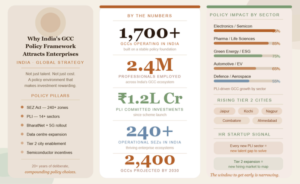
Since its launch, the PLI scheme has
attracted over ₹1.2 lakh crore in committed investments and is directly responsible for
pulling several global manufacturers into India who may not have considered the country as a
serious manufacturing destination even five years ago.
India’s digital infrastructure policy deserves equal attention. The government’s investments
in BharatNet, 5G rollout, and data centre capacity expansion are creating the connectivity
backbone that modern GCCs depend on. Cloud-first operations, real-time data analytics, and
AI-driven workflows all require robust, low-latency digital infrastructure and India is
building that infrastructure at a scale and speed that is genuinely impressive.
For HR startups and talent strategy leaders, the policy environment creates both tailwinds
and specific workforce demands. Every new sector unlocked by PLI or SEZ incentives creates
a new wave of capability requirements that the talent market needs to catch up with.
Semiconductor design, green energy engineering, defence technology, and advanced
manufacturing are all areas where GCC demand is outpacing supply