

When most people think about Global Capability Centres in India, they picture glass office
towers in Bengaluru filled with software engineers and data scientists. Manufacturing GCCs
rarely make the headline, but they are quietly becoming one of the most economically
significant shifts happening in India’s enterprise landscape right now. For HR leaders,
workforce strategists, and startup founders building for the future of work, understanding the
hidden economics behind manufacturing GCCs is not optional — it is essential.
Global industrial giants across aerospace, automotive,
semiconductors, chemicals, and precision engineering are now setting up captive centres in
India not just to save money, but to access deep engineering talent, run R&D operations, and
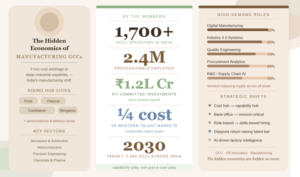
build supply chain intelligence capabilities. India currently has over 1,700 GCCs employing
close to 2.4 million professionals, and manufacturing-linked GCCs are among the fastestgrowing segments within this number.

The economics become interesting when you look beneath the surface. Setting up a
manufacturing GCC in India costs significantly less than an equivalent centre in Germany, the
United States, or Japan — but the gap in output quality is narrowing every year. A senior
mechanical engineer or supply chain analyst in India earns roughly one-third to one-fourth of
what their counterpart would cost in a Western market, while delivering comparable or in
many cases superior technical depth.
The Production Linked
Incentive (PLI) scheme, covering sectors from electronics to pharmaceuticals to advanced
chemistry, has brought in over ₹1.2 lakh crore in committed investments since its launch. The
government’s push on semiconductor manufacturing, defence production, and green energy
infrastructure is creating entirely new capability requirements that GCCs are uniquely
positioned to fulfil.
The talent profiles required are more specialised
and harder to find at scale. Roles in digital manufacturing, Industry 4.0 systems, quality
engineering, and procurement analytics are in high demand but short supply. Upskilling
pipelines need to be built from scratch in many cases, because the Indian education system
has historically produced more software generalists than advanced manufacturing
specialists.
AI and automation are reshaping what manufacturing GCCs actually do. These centres are no
longer just processing purchase orders or drafting technical documentation. They are running
predictive maintenance models, digital twin simulations, and AI-driven quality control
systems that feed directly into factory floors thousands of miles away.
The work being done
in India is increasingly mission-critical, which means the workforce managing it needs both
technical precision and strategic thinking — a combination that demands a very different
approach to hiring and retention than traditional GCC models.
India’s manufacturing GCC story is still early, but the economics are already speaking clearly.
The country is building deep industrial capability at a fraction of the global cost, backed by
policy momentum and a talent pool that is evolving rapidly. For businesses that understand
this early, and for HR innovators who build the right tools to support it, the opportunity
ahead is substantial.