

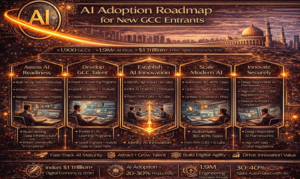
An AI adoption roadmap helps organizations integrate artificial intelligence and automation
into their operations in a structured and sustainable way. Instead of implementing AI tools
randomly, companies follow a clear plan that aligns technology with business goals,
workforce capabilities, and operational strategy.
One of the biggest GCC trends today is the shift from traditional shared services to digital
innovation hubs. Earlier GCCs mainly focused on IT support, finance operations, or customer
service. This transformation is driven by AI and automation technologies that can handle 30–
40% of repetitive enterprise tasks, enabling employees to focus on higher-value work such as
problem-solving, product innovation, and strategic decision-making.

AI systems rely on high-quality data, cloud computing capabilities, and
secure technology platforms. Organizations must invest in modern data architecture and
governance frameworks before scaling AI initiatives. Without strong data foundations, AI
models cannot generate reliable insights.
The second stage focuses on talent strategy and workforce readiness. AI adoption is not just
about technology; it is about people who can build, manage, and improve intelligent systems.
Organizations must invest in training programs
that develop AI skills, data analytics expertise, and automation capabilities. Companies that
actively reskill employees often achieve 20–30% productivity improvements, demonstrating
the value of continuous learning.
Modern HR teams are using AI-powered recruitment tools, predictive workforce analytics,
and digital learning platforms to manage talent more effectively. Automation is also
improving internal HR operations by streamlining processes such as onboarding, payroll
management, compliance tracking, and employee engagement analysis. For HR startups,
these solutions represent a growing opportunity to support GCCs in building agile and futureready workforce systems.
Successful AI initiatives require collaboration between technology teams, business leaders,
and data specialists. GCCs must encourage experimentation and innovation by creating
environments where employees can test AI ideas and develop prototypes. Many
organizations establish internal innovation labs or centers of excellence to accelerate AI
adoption and share best practices across teams.
India’s evolving role in global enterprise strategy makes this roadmap even more significant.
Many multinational corporations are assigning global AI mandates to their Indian GCCs
because of the country’s deep talent pool, strong technology ecosystem, and experience in
managing large-scale digital operations.
In conclusion, an AI adoption roadmap provides new GCC entrants with a clear path to
building intelligent, scalable, and future-ready operations. By aligning technology
investments, talent development, HR innovation, and governance frameworks, organizations
can unlock the full potential of AI and automation.