

For decades, standard job descriptions followed a predictable formula: a list of required
qualifications, years of experience, and a bulleted list of daily operational tasks—writing
code, managing spreadsheets, drafting reports, or scheduling meetings. However, as
artificial intelligence shifts from external productivity add-on to core enterprise
infrastructure, the legacy job post has become obsolete. In 2026, forward-thinking Global
Capability Centers (GCCs) and global product firms are no longer writing job requisitions
for human execution alone. They are publishing AI-first job descriptions—frameworks
that define a role by human-AI orchestration, system output, and algorithmic oversight
rather than manual task completion.
This shift in role design is redefining broader GCC trends across India. The nation’s
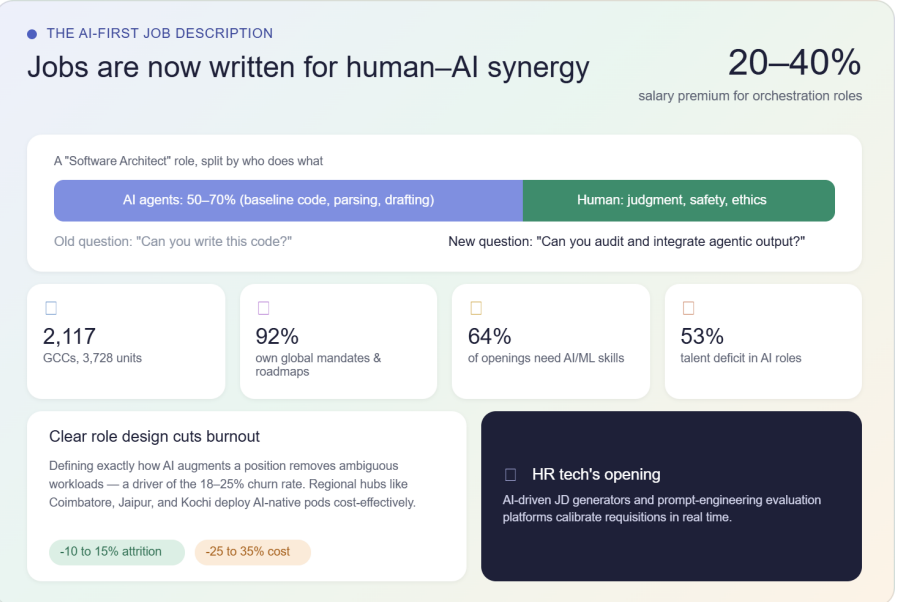
ecosystem now encompasses 2,117 active GCCs operating across 3,728 units,
representing a $98.4 billion economic market that employs over 2.36 million skilled
professionals. Crucially, with 92% of capability centers owning global process mandates
and product roadmaps, enterprises are fundamentally re-architecting how work is
assigned. When a center posts an opening for a “Software Architect” or “Financial Analyst,”
the description explicitly assumes that 50% to 70% of baseline code generation, data
parsing, and report drafting is handled by autonomous agents. Instead of asking “Can
you write this code?”, the modern job description asks “Can you evaluate, audit, and
integrate agentic output into complex enterprise systems?”
The catalyst accelerating AI-first role design is the rapid integration of AI and automation
across corporate architecture. With 64% of all new GCC job openings mandating
advanced AI or machine learning capabilities against an industry-wide 53% talent
deficit in specialized AI roles, organizations cannot afford to evaluate talent based on
legacy criteria. AI-first job descriptions break roles down into specific human-AI
workflows: the AI agent provides velocity and scale, while the human professional
provides contextual judgment, architectural safety, and ethical governance. Specialized
roles command 20% to 40% salary premiums, signaling that enterprises value
orchestration capability far above traditional routine execution.
Designing jobs around human-AI collaboration reflects progressive future-of-work
thinking that transforms overall enterprise talent strategy. By explicitly defining how AI
tools augment a position, organizations eliminate ambiguous workloads that cause
employee burnout and voluntary tech churn, which lingers between 18% and 25% across
major tech corridors. To deploy these AI-native roles without incurring extreme
compensation spikes in primary metros like Bengaluru and Hyderabad, global firms are
expanding into emerging secondary hubs like Coimbatore, Jaipur, and Kochi. Establishing
specialized engineering spokes in regional centers enables GCCs to achieve 10% to 15%
lower voluntary attrition rates while securing 25% to 35% in overall operational cost
savings, creating stable environments for high-density capability pods.
This structural rewrite of job architecture creates an extraordinary growth vector for HR
innovation, driving rapid market adoption for agile B2B HR startups. Legacy applicant
tracking systems built to match static resume keywords fail to assess a candidate’s ability
to direct autonomous agents. High-growth HR tech startups developing AI-driven job
description generators, live sandbox assessment tools, prompt-engineering evaluation
platforms, and dynamic skill-graph matching engines are achieving rapid enterprise
integration. Modern talent platforms empower talent acquisition teams to calibrate job
requisitions in real time, shortening specialist recruitment cycles from months down to
days.