

For decades, enterprise headcount expansion followed a rigid annual calendar: finance approved static
hiring quotas in Q1, human resources spent months posting generic job descriptions, and business
units waited for fixed quarterly intake cycles. However, as global capability centers transition into highvelocity technology command centers, the traditional annual recruitment blueprint has broken down. In
a market where product roadmaps shift quarterly, automated workflows re-architect team structures
overnight, and technical skill halflives drop below 24 months, relying on static annual hiring plans
creates severe operational drag.
This strategic pivot is fundamentally transforming macro GCC trends across the country.
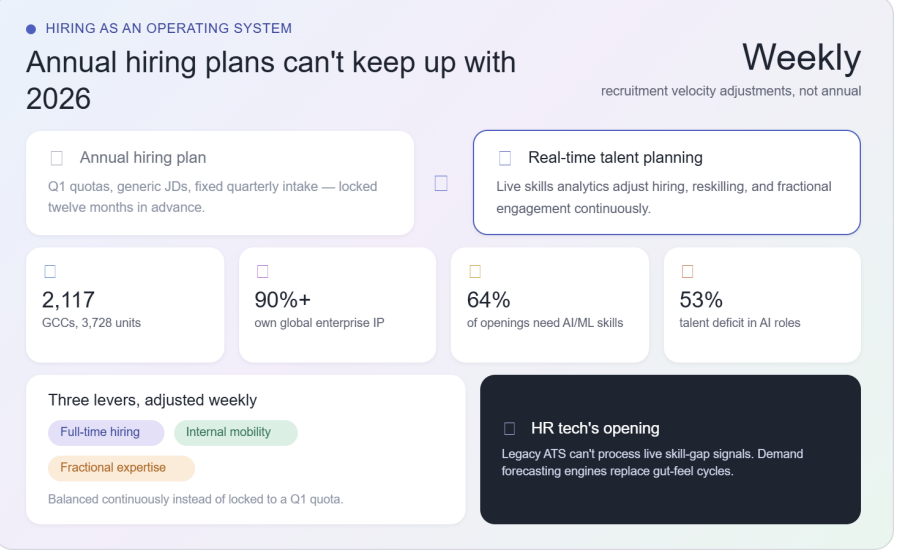
India currently hosts 2,117 active GCCs operating across 3,728 distinct units, forming a $98.4 billion
economic sector that employs over 2.36 million skilled professionals. Crucially, because over
90% of these hubs operate as multi-functional innovation centers owning global enterprise IP,
local delivery teams can no longer predict their workforce needs twelve months in advance.When a
parent organization launches an urgent cloud migration or deploys a new agentic AI workflow, waiting
for the next annual hiring cycle means missing global delivery windows. Real-time talent planning
allows GCCs to dynamically adjust recruitment velocity, internal reskilling pipelines, and fractional
expert engagements on a weekly basis.

The primary catalyst accelerating this shift toward continuous workforce orchestration is the rapid
integration of AI and automation across business infrastructure. As intelligent platforms continuously
absorb routine coding, testing, and operational support tasks, headcount needs fluctuate dynamically
based on project complexity rather than raw seat count.With 64% of all new GCC job openings
mandating advanced AI or machine learning capabilities against an industry-wide 53% talent
deficit in specialized AI roles, annual hiring forecasts fail to reflect real-time skill gaps. By tracking
live workforce capabilities, GCCs can immediately identify emerging skill shortages, trigger internal
upskilling tracks, and target niche talent before skill bottlenecks disrupt global product roadmaps.
Embracing dynamic talent planning reflects progressive future-of-work thinking that rebuilds overall
enterprise talent strategy. Instead of treating recruitment as a reactive reaction to resignation letters,
GCCs use real-time talent analytics to balance full-time hiring, internal mobility, and fractional expertise.
To execute these agile talent models without facing hyper-inflation in primary metros like Bengaluru and
Hyderabad, global firms are expanding into emerging secondary hubs like Coimbatore, Jaipur, and
Kochi. Establishing regional talent spokes enables GCCs to achieve 10% to 15% lower voluntary
attrition rates while securing 25% to 35% in overall operational cost savings, creating stable
environments for continuous skills mapping.
This migration from static annual hiring to real-time workforce planning presents an extraordinary
growth vector for HR innovation, driving rapid market adoption for agile B2B HR startups. Legacy
applicant tracking systems designed for annual headcount tracking cannot process continuous skillgap inputs or real-time labor market signals. High-growth HR tech startups developing AI-driven
workforce demand forecasting engines, live talent market intelligence platforms, automated internal
mobility marketplaces, and predictive attrition models are seeing rapid enterprise integration. Modern
workforce intelligence platforms empower HR leaders to replace slow, gut-feel recruitment cycles with
continuous data-driven talent deployment.