

For decades, enterprise human resources was built on static organizational charts, job titles, and
headcount tracking—what the industry historically called an “employee inventory.” An organization
knew it had 500 “Senior Software Engineers” or 50 “Business Analysts” on the books. However, in an
era where AI agents write boilerplate code, automated pipelines manage infrastructure, and technical
skill decay occurs in under 24 months, managing a workforce by job titles has become dangerously
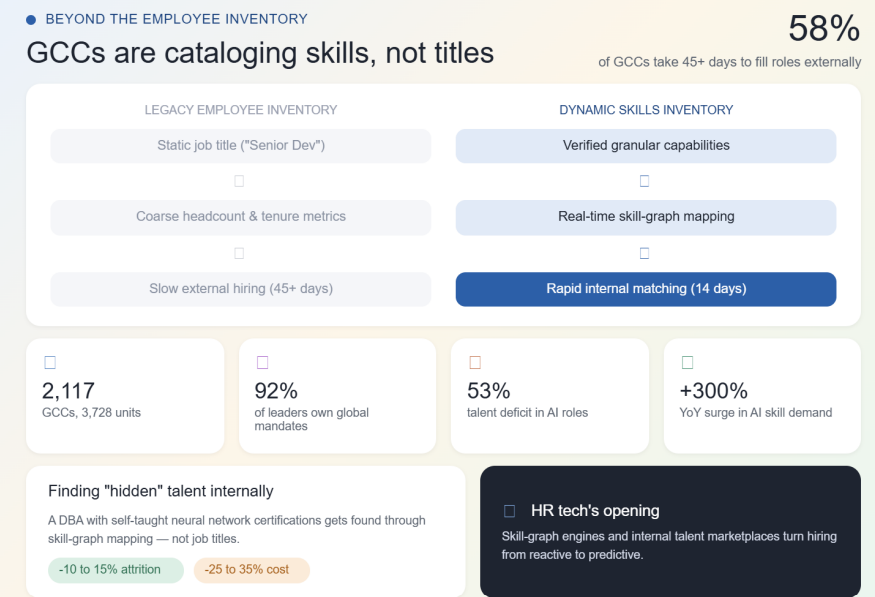
obsolete. Forward-thinking Global Capability Centers (GCCs) in India are replacing legacy headcount
lists with dynamic skills inventories—real-time, AI-mapped databases that catalog the granular,
verified capabilities of every individual across the enterprise.
This operational pivot is redefining broader GCC trends across the country. India currently hosts 2,117
active GCCs operating across 3,728 units, forming a $98.4 billion economic market that employs
over 2.36 million skilled professionals. Crucially, with 92% of GCC leaders confirming their
centers own global process mandates and enterprise product roadmaps, centers can no longer
afford to view talent through vague titles.When a global enterprise needs to deploy an emergency
agentic-AI security patch or build a custom LLM fine-tuning pipeline, searching an “employee
inventory” for “Lead Engineer” yields zero actionable insight. Conversely, a live skills inventory instantly
identifies the exact five engineers who possess MLOps, PyTorch, and Zero-Trust architecture
capabilities, regardless of their official job titles.

The catalyst accelerating this shift toward skills-based architecture is the deep integration of AI and
automation across enterprise workflows. As routine execution tasks are handled by autonomous
software, the market faces an industry-wide 53% talent deficit in specialized AI roles alongside a
300% surge in AI skill demand.With 58% of GCCs taking over 45 days to fill critical technical
roles externally, searching internally via a skills inventory allows organizations to discover “hidden”
talent—such as a database administrator who completed advanced neural network certifications
independently.This enables “role-adjacent reskilling,” cutting time-to-productivity from months down to
weeks while avoiding heavy external headhunting premiums.
Designing workforce strategy around skills inventories represents progressive future-of-work
thinking that rebuilds overall enterprise talent strategy. By decoupling work from rigid job titles and
assigning tasks based on verified competencies, GCCs maximize capability density per seat.To
maintain these skills ecosystems without facing extreme salary inflation in primary hubs like Bengaluru
and Hyderabad, global firms are expanding into secondary technology hubs like Coimbatore, Jaipur,
and Kochi. Establishing specialized learning spokes in regional centers enables GCCs to achieve 10%
to 15% lower voluntary attrition rates while securing 25% to 35% in operational cost savings,
creating stable environments where employees continuously upgrade their technical skill profiles.
Legacy HR management systems designed for static
payroll and title tracking cannot map dynamic, multi-dimensional skill relationships. High-growth HR
tech startups developing AI-powered skill-graph engines, contribution-based portfolio analytics, realtime internal talent marketplaces, and predictive skill-decay analytics are achieving rapid enterprise
integration. Modern talent intelligence platforms empower HR leaders to audit workforce capabilities in
real time, transforming talent acquisition from a reactive headhunting exercise into a predictive, datadriven science.