

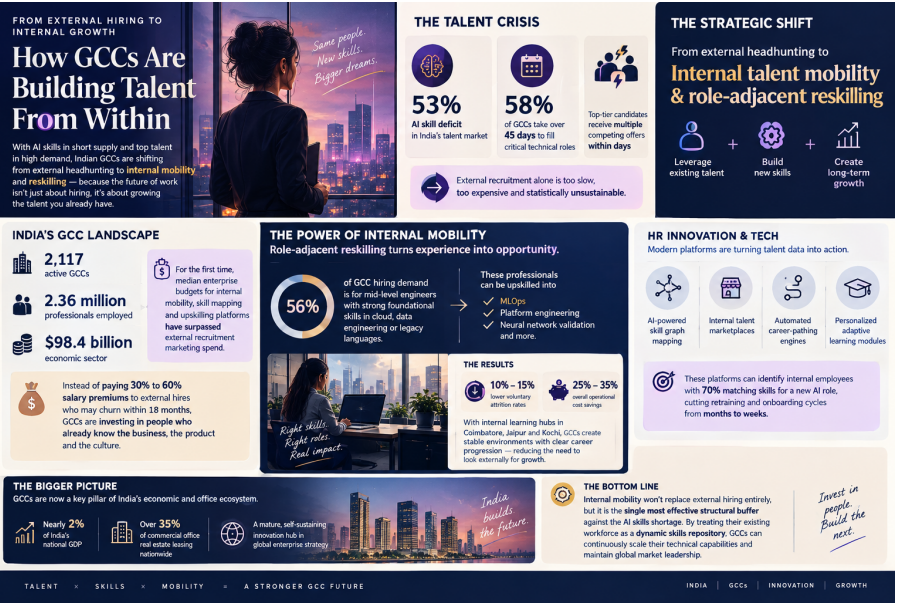
As India’s Global Capability Centers (GCCs) face a talent market where the AI skill deficit
hovers around 53%, talent acquisition leaders are coming to a stark realization: they cannot
external-hire their way out of a talent crisis. With 58% of GCCs taking over 45 days to fill
critical technical roles and top-tier candidates receiving multiple competing offers within
days, external recruitment alone is proving too slow, too expensive, and statistically
unsustainable. To solve this acute talent bottleneck, forward-thinking organizations are
making a decisive operational shift: transitioning from external headhunting to internal
talent mobility and role-adjacent reskilling.
This strategic tilt toward “building over buying” is fundamentally redefining GCC trends
across the country. India currently hosts 2,117 active GCCs employing 2.36 million
professionals within a $98.4 billion economic sector. For the first time, median enterprise
budgets dedicated to internal mobility, skill mapping, and internal upskilling platforms have
officially surpassed external recruitment marketing spend. Rather than paying 30% to 60%
salary premiums to recruit external talent who may churn within 18 months, GCCs are
realizing that internal talent already possesses deep institutional knowledge, product domain
fluency, and cultural alignment—making them the fastest pipeline for advanced capability
building

The key lies in “role-adjacent reskilling”— taking experienced mid-level engineers (who represent 56% of overall GCC hiring demand)
with strong foundational logic in cloud, data engineering, or legacy languages, and
transitioning them into MLOps, platform engineering, or neural network validation roles.
Furthermore, by establishing internal learning hubs across regional spokes like Coimbatore,
Jaipur, and Kochi, GCCs can achieve 10% to 15% lower voluntary attrition rates while
securing 25% to 35% in overall operational cost savings, creating stable environments
where employees see a clear long-term career progression rather than looking externally for
growth.
This migration toward skills-based internal talent mobility presents an extraordinary growth
vector for HR innovation, accelerating market adoption for agile B2B HR startups.
Traditional HR management systems that track static job descriptions and tenure fail to reveal
an employee’s latent capabilities.Modern
talent mobility platforms allow enterprise HR leaders to instantly identify internal employees
with 70% matching skills for a new AI role, cutting retraining and onboarding cycles from
months down to weeks.
Clear policy and economic signals confirm India’s evolving role in global enterprise
strategy as a mature, self-sustaining innovation hub. Accounting for nearly 2% of India’s
national GDP and absorbing over 35% of commercial office real estate leasing
nationwide, GCCs cannot rely on fragile external talent supply chains. Internal mobility will
not replace external hiring entirely, but it is the single most effective structural buffer against
the AI skills shortage. By treating their existing workforce as a dynamic skills repository
rather than a static headcount list, GCCs ensure they can continuously scale their technical
capabilities and maintain global market leadership.