

For decades, the dominant narrative surrounding Global Capability Centers (GCCs) in
India focused almost entirely on technical scale. India was celebrated as the ultimate
engineering engine—a reliable pipeline for back-end software development, IT
infrastructure, and automated testing. However, as GCCs shift from operational delivery
centers to full-scale enterprise innovation hubs, pure engineering capacity is no longer
sufficient. Long-term expansion now depends on non-engineering domain experts,
strategic cross-functional leaders, and specialized operational capabilities.
A software engineering pod can write code, but without strategic product leadership, it
remains an execution arm rather than an outcome driver. GCCs are increasingly
acquiring global P&L responsibility, requiring Product Managers who act as “mini-CEOs”.
These leaders manage global product roadmaps, conduct market research across
regions, and determine feature prioritization. Without strong non-engineering product
strategists and UI/UX designers, engineering teams risk building technically sound
systems that fail commercial validation.

An AI algorithm developed for risk modeling is only as effective as the underlying financial
or regulatory knowledge embedded within it. GCCs in Banking, Financial Services, and
Insurance (BFSI), Healthcare, and Supply Chain require quantitative analysts, regulatory
compliance experts, actuary leads, and medical researchers. As AI handles routine
code syntax, the competitive advantage shifts toward domain experts who specify
business rules, audit algorithmic logic, and ensure multi-jurisdictional compliance.
Managing multi-thousand-person centers across primary and secondary tech hubs
demands modern human capital management. With 92% of India GCC leaders taking on
end-to-end global process ownership, functions like Talent Acquisition, Strategic HR
Business Partnering (HRBP), and Learning & Development (L&D) are crucial. Experienced
HR leaders design competitive compensation strategies, build specialized upskilling
pipelines for legacy workers, and mitigate attrition in hyper-competitive corridors.
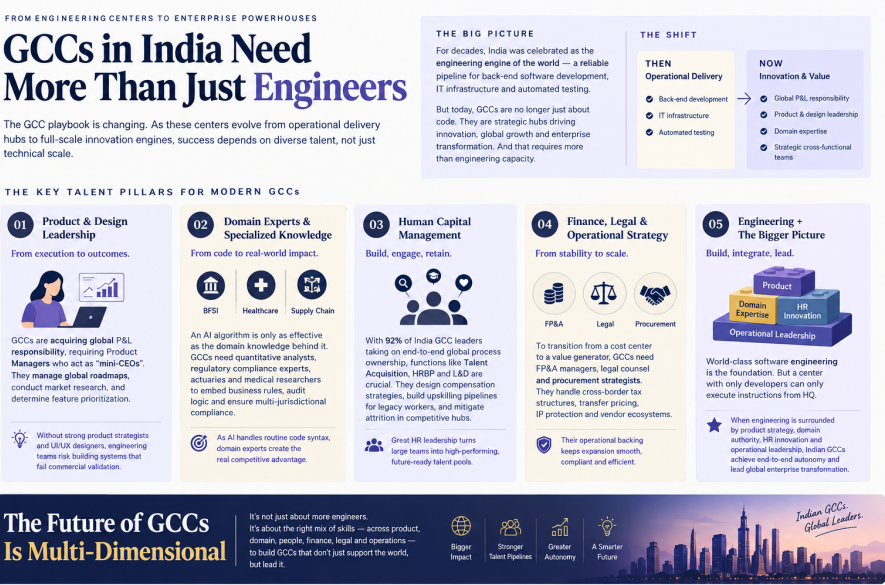
Transitioning a GCC from a cost center to a value generator requires robust financial and
legal architecture. Financial Planning & Analysis (FP&A) managers, legal counsel, and
procurement strategists oversee cross-border tax structures, transfer pricing
compliance, intellectual property protection, and vendor ecosystems. Their operational
backing enables technical teams to expand without incurring regulatory friction or
financial inefficiencies.
While world-class software engineering remains a core foundation, a center composed
solely of developers can only execute instructions passed down from global
headquarters. By surrounding engineering capability with product strategy, domain
authority, HR innovation, and operational leadership, Indian GCCs secure the end-to-end
autonomy required to lead global enterprise transformation.