

For decades, enterprise success was defined by building large campuses, managing vast operational
support teams, and onboarding thousands of fresh engineering graduates each quarter.
However, in 2026, as autonomous AI agents, automated development pipelines, and
predictive algorithms take over routine code maintenance and L1 operational support,
expanding physical seat counts yields diminishing returns. Modern enterprise
boardrooms are shifting their recruitment philosophies from volume-driven hiring to
talent density and capability ownership.
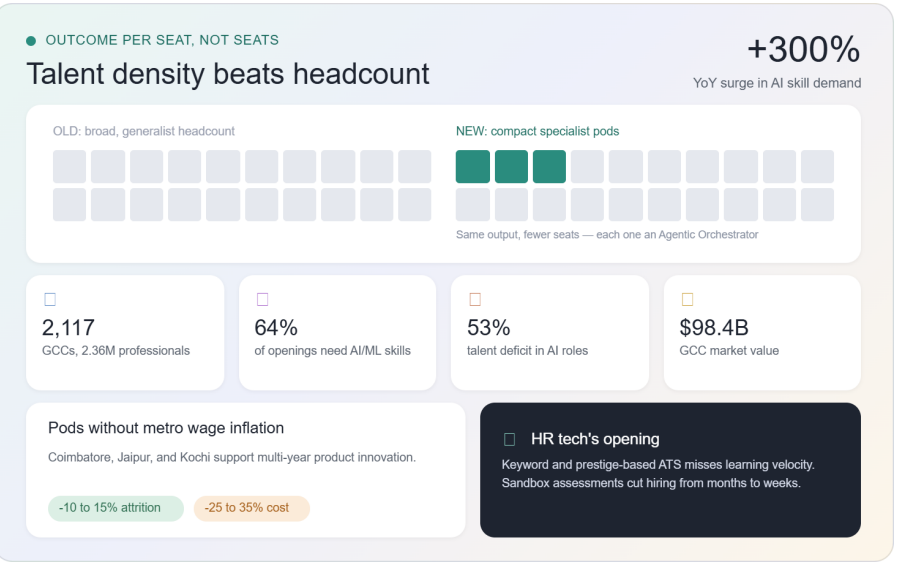
The national ecosystem now encompasses 2,117 active GCCs employing over 2.36
million skilled professionals and generating $98.4 billion in annual market value.
Crucially, as over 90% of these hubs operate as multi-functional innovation centers
owning global product roadmaps, parent organizations are no longer evaluating Indian
centers by the size of their balance sheets or headcount. When an Indian center takes full
global accountability for a core enterprise function, adding low-complexity seats creates
operational friction and management overhead.

Routine execution tasks—such as
boilerplate code generation, manual regression testing, basic data formatting, and
standard support tickets—are systematically handled by intelligent software. With 64% of
all new GCC job openings mandating advanced AI, machine learning, or intelligent
automation capabilities, the market faces an industry-wide 53% talent deficit in
specialized AI roles alongside a 300% surge in AI skill demand year-over-year. Rather
than building large teams of generalist coders, GCCs are forming compact, high-density
pods of “Agentic Orchestrators” who direct AI models, govern algorithmic risk, and
architect resilient enterprise systems.
Organizations are abandoning
broad volume hiring, focusing instead on internal skills-mapping and dynamic capability
metrics. To assemble high-density engineering pods without driving hyper-inflation in
primary metros like Bengaluru and Hyderabad, global firms are decentralizing their
footprints into emerging secondary hubs like Coimbatore, Jaipur, and Kochi. Establishing
specialized engineering spokes in these regional centers enables GCCs to secure 10% to
15% lower voluntary attrition rates while achieving 25% to 35% in overall operational
cost savings, creating stable environments where high-performing talent can focus on
multi-year product innovation.
This migration from headcount tracking to capability density creates an extraordinary
growth vector for HR innovation, accelerating market adoption for agile B2B HR startups.
Legacy applicant tracking systems designed to screen resumes based on keyword
matching or university prestige fail to measure an applicant’s real-time technical
execution skills or learning velocity. High-growth HR tech startups developing AI-driven
skill-graph evaluation engines, live sandbox work-sample assessments, real-time
compensation intelligence tools, and predictive candidate retention analytics are
achieving rapid enterprise integration.