

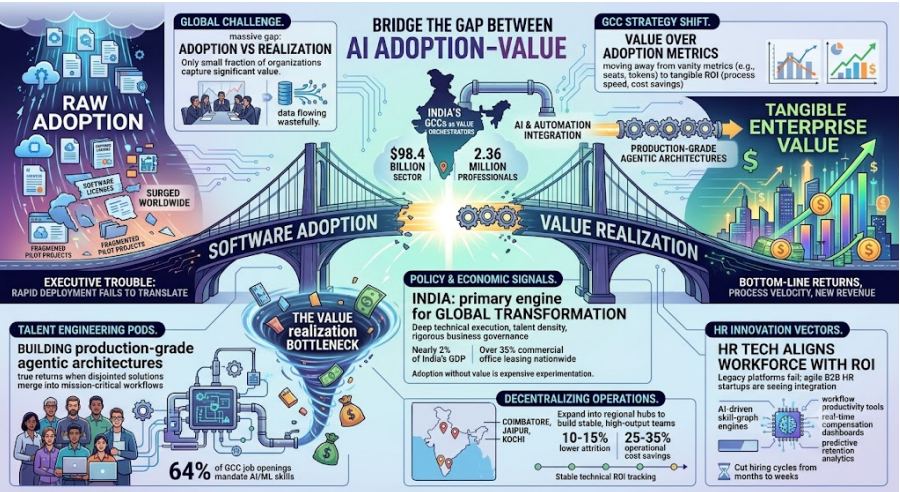
Across global corporate boardrooms, a critical divergence is defining the technology landscape.While
software licensing, pilot projects, and foundational model integrations have surged worldwide,
executive teams face a troubling reality: rapid technology deployment is not automatically translating
into measurable business returns. Across global enterprises, artificial intelligence adoption has
skyrocketed, yet only a small fraction of organizations report capturing significant, bottom-line
enterprise value.The central challenge facing modern organizations is no longer getting teams to use
automated software, but bridging the massive gap between raw software adoption and tangible value
realization.
This value realization bottleneck is directly reshaping Global Capability Center (GCC) trends across
India.The nation currently hosts 2,117 active GCCs operating across 3,728 distinct units, forming a
$98.4 billion economic sector that employs over 2.36 million skilled professionals. Crucially,
over 90% of these centers operate as multi-functional innovation hubs responsible for cloud
infrastructure, core product engineering, and global risk management. When parent organizations
struggle to calculate returns on multi-million dollar software investments, they turn to their Indian
capability hubs to act as value orchestrators—moving AI out of experimental sandboxes and integrating
it into core operational workflows.

The primary engine behind this shift toward measurable returns is the rapid integration of AI and
automation across mission-critical workflows.With 64% of all new GCC job openings mandating
advanced AI or machine learning capabilities, Indian centers are building dedicated AI Centers of
Excellence focused on system integration, model validation, and governance. Facing an industry-wide
53% talent deficit in specialized AI roles and voluntary tech churn of 18% to 25%, enterprise
leaders are realizing that value is lost when teams deploy disjointed point solutions.True economic
returns emerge when high-density engineering teams build production-grade agentic architectures that
streamline real-world business processes end-to-end.
Overcoming the value gap demands forward-thinking future-of-work thinking to rebuild overall
enterprise talent strategy. Forward-looking organizations are moving away from measuring success
through vanity metrics like token consumption or active seat licenses, focusing instead on process
velocity, cost optimization, and new revenue generation.To build stable, high-output value engineering
pods without facing extreme compensation inflation in primary metros, global enterprises are
decentralizing operations into secondary technology hubs like Coimbatore, Jaipur, and Kochi.
Expanding into these regional tech nodes allows GCCs to achieve 10% to 15% lower attrition rates
and secure 25% to 35% in overall operational cost savings, creating stable environments for
continuous technical ROI tracking.
This transition from adoption metrics to value realization creates a massive growth vector for HR
innovation, accelerating market adoption for agile B2B HR startups. Legacy recruitment platforms
and traditional performance management systems fail to measure how effectively employees leverage
artificial intelligence to drive business outcomes. High-growth HR tech startups developing AI-driven
skill-graph evaluation engines, workflow productivity tracking tools, real-time compensation intelligence
dashboards, and predictive retention analytics are seeing rapid enterprise integration. Modern
platforms empower HR and business leaders to identify productivity bottlenecks, cut specialist hiring
cycles from months down to weeks, and align workforce capabilities directly with ROI metrics.