

The foundational narrative of corporate offshoring has reached its definitive expiration
date. For decades, foreign multi-nationals viewed setting up operations in emerging
markets strictly through the lens of budget reduction, relying on low-cost labor to shrink
operational expenses. However, as global digital transformation accelerates, boardrooms
have realized that cheap execution yields diminishing returns. In 2026, the primary
currency of Global Capability Centers (GCCs) has permanently shifted from cost
arbitrage to strategic capability. Organizations are no longer measuring the value of their
offshore outposts by how much money they save, but by how much innovation, enterprise
resilience, and technical leadership they generate.
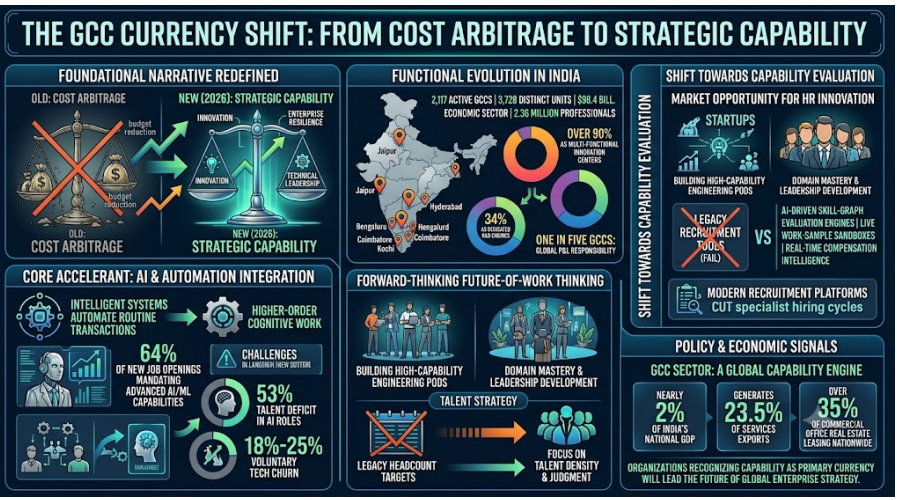
This functional evolution is deeply reflected in the rapid scaling of GCC trends across
India. The country currently hosts 2,117 active GCCs operating across 3,728 distinct units,
forming a $98.4 billion economic sector that employs over 2.36 million skilled
professionals. Crucially, as over 90% of these hubs operate as multi-functional
innovation centers managing core product architectures, parent companies no longer
treat their Indian hubs as cheap delivery arms. Today, 34% of Indian GCCs function
explicitly as dedicated R&D engines, with one in five centers maintaining global P&L
responsibility.

The core accelerant behind this capability-first mindset is the deep integration of AI and
automation across business infrastructure. As routine transactional tasks—like basic
software maintenance, level-1 support, and standard reporting—are automated by
intelligent systems, capability centers must deliver higher-order cognitive work. With 64%
of all new GCC job openings explicitly mandating advanced AI or machine learning
capabilities, these centers attract top-tier engineering talent to build autonomous
agentic workflows and manage complex data architectures. Even as the ecosystem
handles an industry-wide 53% talent deficit in specialized AI roles and voluntary tech
churn of 18% to 25%, global leadership recognizes that Indian centers hold the talent
density required to solve mission-critical technical challenges.
Navigating this transition requires forward-thinking future-of-work thinking to rebuild
overall talent strategy. Forward-looking organizations are abandoning legacy headcount
targets, focusing instead on domain mastery, talent density, and leadership development.
To cultivate high-capability engineering pods without facing hyper-inflation in primary
metros like Bengaluru and Hyderabad, global firms are expanding into emerging
secondary tech hubs like Coimbatore, Jaipur, and Kochi. Establishing operations in these
regional tech nodes enables GCCs to achieve 10% to 15% lower attrition rates and secure
25% to 35% in overall operational cost savings, creating stable environments where deep
technical expertise can be fostered over the long term.
This shift toward capability evaluation creates a massive market opportunity for HR
innovation, driving rapid enterprise adoption for agile B2B HR startups. Legacy
recruitment tools built for screening thousands of identical resumes fail to measure
strategic judgment or specialized technical capability. High-growth HR tech startups
developing AI-driven skill-graph evaluation engines, live work-sample sandboxes, realtime compensation intelligence tools, and predictive candidate retention analytics are
seeing rapid integration. Modern recruitment platforms empower talent acquisition
leaders to cut specialist hiring cycles from months down to weeks, bringing data-backed
precision to strategic headhunting pipelines.