

When enterprise boards evaluate their artificial intelligence roadmaps, discussions almost exclusively
focus on technology stacks: selecting foundational LLMs, securing graphics processing
infrastructure, or establishing data pipelines. However, as organizations deploy production-grade
intelligent systems, they uncover a striking operational reality: technical infrastructure rarely causes AI
initiatives to stall. Instead, the primary bottleneck holding back enterprise transformation is workforce
readiness. Deploying autonomous software agents and predictive analytics across complex
corporate environments requires an agile workforce capable of working alongside intelligent systems
a capability that many legacy enterprise teams still lack.

This human readiness gap directly impacts the rapid growth of Global Capability Center (GCC)
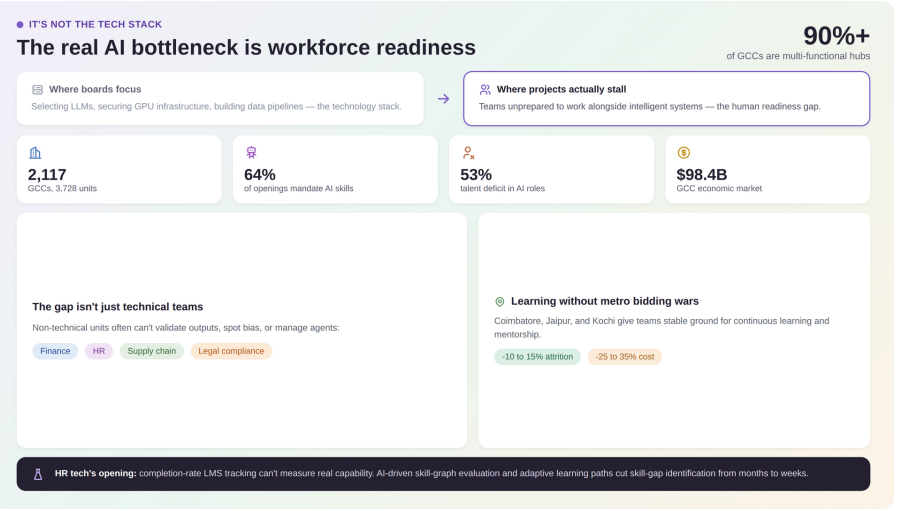
trends across India. India currently hosts 2,117 active GCCs operating across 3,728 distinct units,
representing a $98.4 billion economic market that employs over 2.36 million skilled
professionals. Crucially, over 90% of these centers operate as multi-functional innovation hubs
owning core cloud frameworks, product engineering, and global risk management. Yet, while global
enterprises look to Indian centers to lead digital transformation, deploying advanced tools without
structured upskilling leaves teams struggling to translate raw algorithms into measurable business
outcomes.
The integration of AI and automation across corporate workflows highlights how quickly technical
tasks are shifting. With 64% of all new GCC job openings mandating advanced AI or machine
learning capabilities, demand for specialized skills has created an industry-wide 53% talent deficit
in AI roles, keeping voluntary tech churn at 18% to 25%. However, the talent gap extends beyond
data science and engineering teams. Non-technical business units—spanning corporate finance,
human resources, supply chain, and legal compliance—frequently lack the functional AI literacy
needed to validate model outputs, spot algorithmic bias, or manage automated digital agents
effectively.
Closing this gap demands progressive future-of-work thinking to reshape enterprise talent
strategy. Forward-looking organizations are moving away from passive classroom lectures, opting
instead for immersive learning, scenario-based sandboxes, and cross-functional hackathons. To build
AI-ready talent pools without driving hyper-inflation in saturated metropolitan hubs, global
enterprises are expanding into secondary tech ecosystems like Coimbatore, Jaipur, and Kochi.
Establishing operations in these regional centers enables firms to achieve 10% to 15% lower attrition
rates and secure 25% to 35% in overall operational cost savings, creating stable environments for
continuous learning and technical mentorship.
This imperative for workforce readiness creates an extraordinary market opportunity for HR
innovation, driving rapid enterprise adoption for agile B2B HR startups. Legacy learning
management systems that track course completion rates fail to measure practical operational
capability. High-growth HR tech startups developing AI-driven skill-graph evaluation engines,
personalized adaptive learning paths, real-time compensation intelligence tools, and predictive
retention analytics are seeing rapid integration. Modern platforms empower talent acquisition and
learning teams to cut skill-gap identification timelines from months down to weeks, bringing databacked precision to enterprise workforce development.