

As autonomous software agents, predictive intelligence, and generative models become deeply
embedded in daily corporate workflows, the traditional definition of workplace productivity is being
permanently rewritten. For recent university graduates, enterprise leaders, and B2B technology
founders, evaluating the future of work requires looking well beyond basic coding or standard data
analysis. By 2030, routine process execution will be completely managed by intelligent digital
systems. To remain competitive in an increasingly automated global economy, professionals must
transition from executing static tasks to orchestrating complex human-machine ecosystems.
This skill transformation directly aligns with the rapid structural growth of Global Capability Center
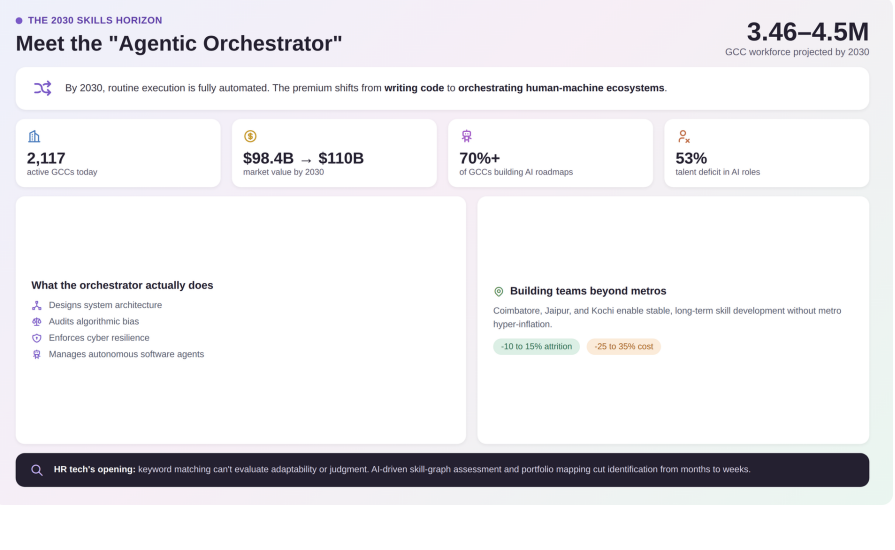
(GCC) trends across India. The country currently hosts 2,117 active GCCs operating across 3,728
distinct units, forming a $98.4 billion economic engine that employs over 2.36 million skilled
professionals. Industry forecasts project that India’s GCC workforce will expand to 3.46 million to
4.5 million professionals by 2030, with industry market value topping $110 billion. Crucially, as
over 90% of these hubs operate as multi-functional innovation centers owning direct global P&L
mandates, the expectations placed on local talent are escalating rapidly.

The primary driver behind this evolving workforce profile is the deep integration of AI and
automation across every corporate function. With over 70% of GCCs actively building dedicated
AI roadmaps and 64% of all new technical openings mandating advanced AI or machine
learning capabilities, legacy engineering skills are becoming commoditized. At the same time, the
market faces an acute 53% talent deficit in specialized AI roles, maintaining voluntary tech churn
rates between 18% and 25%. By 2030, the most sought-after employees will not be those who
manually draft code or generate reports, but “Agentic Orchestrators”—specialists who can design
system architectures, audit algorithmic bias, enforce cyber resilience, and manage autonomous
software agents.
Navigating this changing landscape demands forward-thinking future-of-work thinking to rebuild
enterprise talent strategy. Organizations are moving away from evaluating candidates based on
static job descriptions, opting instead for dynamic capability portfolios. To cultivate these specialized
multi-disciplinary teams without facing hyper-inflation in primary metros, global enterprises are
expanding into emerging secondary tech hubs like Coimbatore, Jaipur, and Kochi. Establishing
operations in these regional centers allows enterprises to achieve 10% to 15% lower attrition rates
while securing 25% to 35% in overall operational cost savings, creating stable environments for
long-term skill development and technical mentorship.
This transition toward hyper-specialized human capability creates an extraordinary opportunity for
HR innovation, driving rapid market adoption for agile B2B HR startups. Legacy applicant tracking
tools that filter resumes using basic keyword matching cannot evaluate an applicant’s adaptability or
problem-solving judgment. High-growth HR tech startups developing AI-driven skill-graph
assessment engines, real-time compensation intelligence dashboards, contribution-based portfolio
mapping, and predictive retention analytics are achieving rapid enterprise adoption. Modern
recruitment platforms empower talent acquisition leaders to cut candidate identification timelines
from months down to weeks, bringing data-backed precision to talent discovery.