

Across India’s technology ecosystem, a fundamental divergence is reshaping the hiring landscape.
While legacy IT services firms face muted net additions, Global Capability Centers (GCCs) are rapidly
expanding, absorbing a dominant share of high-skill engineering talent. The driver behind this shift is
simple: GCCs are hiring specialized artificial intelligence, machine learning, and data engineering
talent significantly faster than traditional IT companies. This trend is not merely a temporary hiring
surge, but a reflection of structural differences in business models, organizational intent, and value
creation.
The primary catalyst is the shift in work ownership. In contrast, GCCs act as direct internal innovation hubs for global
parent enterprises. Indian GCC teams directly own core cloud platforms, global IP development,
proprietary algorithmic models, and enterprise-wide digital architectures. Because GCCs build
products and systems for internal deployment rather than executing third-party client mandates, they
can move from strategy to hiring without waiting for external client approvals.

Furthermore, the integration of AI and automation within GCCs directly feeds their talent acquisition
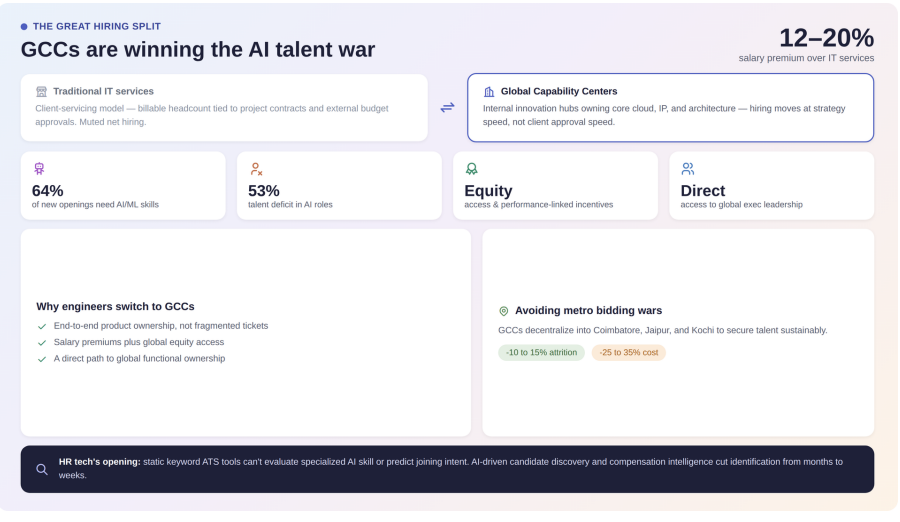
strategy. With 64% of all new GCC openings requiring advanced AI or machine learning
capabilities, these centers are aggressively building dedicated AI Centers of Excellence. This high
demand collides with an industry-wide 53% talent deficit in specialized AI roles, creating intense
competition for qualified engineers. To win this talent race, GCCs leverage distinct structural
advantages over traditional IT services firms:
GCCs routinely offer 12% to 20% salary premiums over traditional IT service firms for equivalent
technical roles, along with performance-linked incentives and global equity access. Candidates work
on end-to-end product engineering rather than outsourced, fragmented client tickets. Additionally,
engineers interact directly with global executive leadership, providing a direct path to global
functional ownership.
Navigating this competitive dynamic requires modern future-of-work thinking to rebuild corporate
talent strategy. To secure scarce specialized talent without driving hyper-inflation in primary metros,
global firms are decentralizing their engineering footprints. Organizations are establishing regional
hubs in secondary cities such as Coimbatore, Jaipur, and Kochi. Expanding into these regional tech
nodes allows GCCs to secure 10% to 15% lower attrition rates and 25% to 35% in overall
operational cost savings, creating stable environments for specialized AI research and platform
engineering.