

In an era dominated by short-form video algorithms and viral social media posts, gaining sudden
online fame has become a sought-after professional milestone. Recent university graduates and
ambitious professionals often chase viral reach, assuming that millions of impressions will
automatically translate into job offers, rapid promotions, and long-term career security. However, in
boardrooms where global enterprise strategy is decided, viral metrics rarely carry real business
weight. While a single trending post might temporarily boost your online engagement, it often fails to
demonstrate the technical competence, strategic judgment, and execution discipline required to
build a multi-decade enterprise career.
This disconnect between viral reach and professional value is particularly evident across expanding
Global Capability Center (GCC) trends in India. The country currently hosts 2,117 active GCCs
operating across 3,728 distinct units, generating $98.4 billion in annual market value and
employing over 2.36 million skilled professionals. Crucially, over 90% of these capability centers
operate as multi-functional innovation hubs, taking direct ownership of core cloud architectures,
complex risk management, and global product development.
Global boardrooms seek individuals with deep domain expertise, proven leadership abilities, and a
track record of driving tangible business outcomes

Modern talent acquisition stacks deploy machine learning to crawl digital ecosystems,
indexing talent based on skill graphs, verified code contributions, and domain-specific problemsolving. With 64% of all new GCC job openings explicitly requiring advanced AI, machine
learning, or intelligent automation capabilities, demand for specialized engineers has created a
53% talent deficit in AI roles, driving voluntary tech churn rates up to 18% to 25%. In a market where
recruiters are desperately searching for niche technical capabilities, a viral post about generic office
culture or trending memes will not pass an AI-driven candidate evaluation filter.
Navigating this reality requires progressive future-of-work thinking to rebuild personal and
corporate talent strategy. Professionals can no longer afford to confuse surface-level popularity with
genuine career currency. Instead, progressive software engineers, product managers, and data
architects focus on targeted visibility—publishing technical deep dives, documenting system
architectural trade-offs, and contributing to open-source communities. Furthermore, as global
enterprises expand into emerging regional technology hubs like Coimbatore, Jaipur, and Kochi—
where operational costs are 25% to 35% lower and attrition drops by 10% to 15%—building deep,
authentic expertise within local talent ecosystems creates far more long-term value than seeking
fleeting global virality
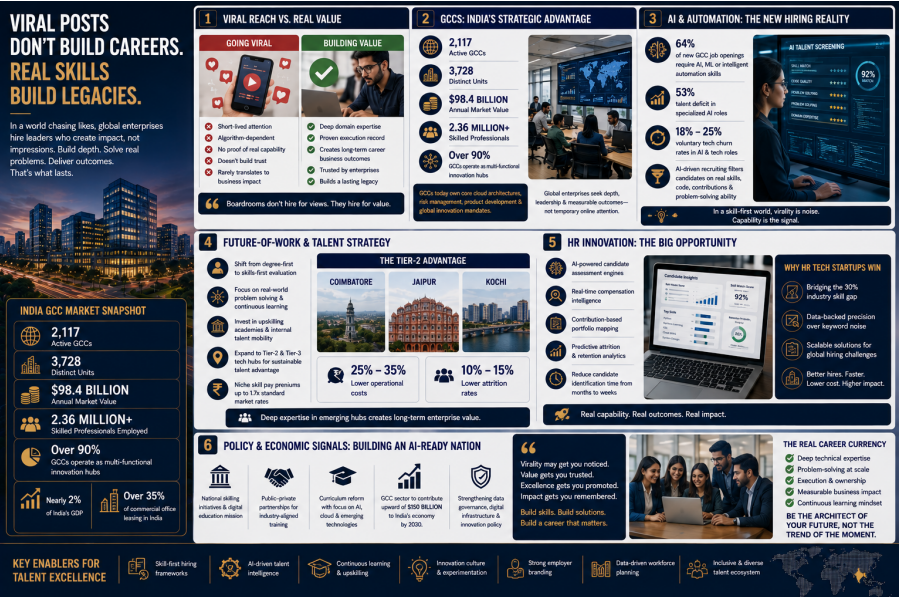
This shift creates a massive window for HR innovation, accelerating market demand for specialized
B2B HR startups. Legacy recruitment systems that screen candidates based on keyword density or
superficial social media metrics fail to evaluate authentic technical capability. High-growth HR tech
startups developing AI-driven candidate assessment engines, real-time compensation intelligence
tools, contribution-based portfolio mapping, and predictive candidate retention analytics are
achieving rapid enterprise adoption. Modern HR platforms allow talent acquisition teams to cut
candidate identification timelines from months down to weeks, bringing data-backed precision to
talent discovery by evaluating real-world capability over superficial digital noise.