
Every year, thousands of exceptionally talented engineers, data scientists, and product leaders build
critical components of the global economy while remaining virtually invisible on professional platforms
like LinkedIn.These hidden domain experts deliver world-class work inside global enterprises, yet their
digital presence consists of little more than an outdated job title and a bare-bones summary. In an era
dominated by automated sourcing and digital personal branding, technical excellence alone no longer
guarantees career visibility. For early-career graduates aiming to build market authority and HR
startups engineering next-generation talent engines, understanding why brilliant professionals stay
hidden is the key to unlocking modern professional growth.
The adoption of AI and automation in talent acquisition makes this digital invisibility particularly costly.
Modern recruitment algorithms and AI sourcing engines continuously crawl public web ecosystems,
evaluating candidate profiles based on published content, domain keywords, and community
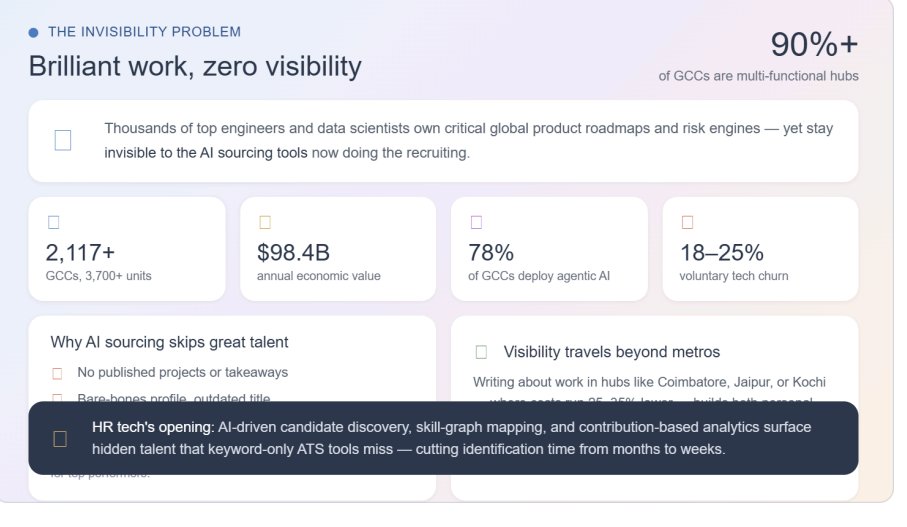
contributions.With over 78% of enterprise GCCs actively deploying Generative AI and agentic
workflows, recruiters are desperately searching for specialists who understand advanced machine
learning architectures.When brilliant professionals fail to document their projects, publish technical
takeaways, or engage in digital discussions, AI sourcing tools routinely pass them over. In a market
where voluntary tech churn sits at 18% to 25%, being invisible on professional networks means
missing out on top-tier global career offers.

Bridging this disconnect requires forward-looking future-of-work thinking to reshape personal and
corporate talent strategy. Progressive organizations recognize that encouraging employees to share
their expertise online is a powerful asset.When engineers write about solving complex architectural
challenges or detail their experience in emerging tech nodes like Coimbatore, Jaipur, or Kochi—where
operational costs are 25% to 35% lower—they elevate both their personal brand and their company’s
employer reputation. Professionals must shift from treating LinkedIn as a static, digital resume to
viewing it as a dynamic portfolio of their problem-solving capability.
This widespread visibility challenge creates a major opportunity for HR innovation, driving demand for
agile B2B HR startups. Legacy applicant tracking platforms miss quiet, high-performing talent
because they rely solely on standard keyword queries. By looking beyond
superficial profile metrics, these modern HR solutions enable hiring teams to cut candidate
identification timelines from months down to weeks, bringing hidden, high-caliber talent directly into
high-value talent pipelines.
Unmistakable policy and economic signals demonstrate that India’s evolving role in global
enterprise strategy relies on visible, world-class leadership.The GCC sector contributes nearly 2%
of India’s national GDP and drives over 35% of commercial office real estate leasing
nationwide, solidifying the country’s status as the world’s primary engine for digital transformation.
Brilliant work deserves to be seen. A resume might document where you have worked, but a strong,
deliberate digital brand ensures that your true expertise is recognized, valued, and rewarded on the
global stage.