

Analyzing attrition trends has evolved from a routine post-exit check into a critical financial
and operational imperative for modern businesses. Boardrooms no longer view employee
departure purely through the lens of human resources; rather, it represents a direct threat to
intellectual property, product delivery timelines, and profit margins. For emerging HR
startups and corporate talent strategists, mastering data-driven exit intelligence is essential
for retaining top talent and building sustainable enterprise growth.
Recent Global Capability Center (GCC) trends clearly illustrate the high financial cost of talent
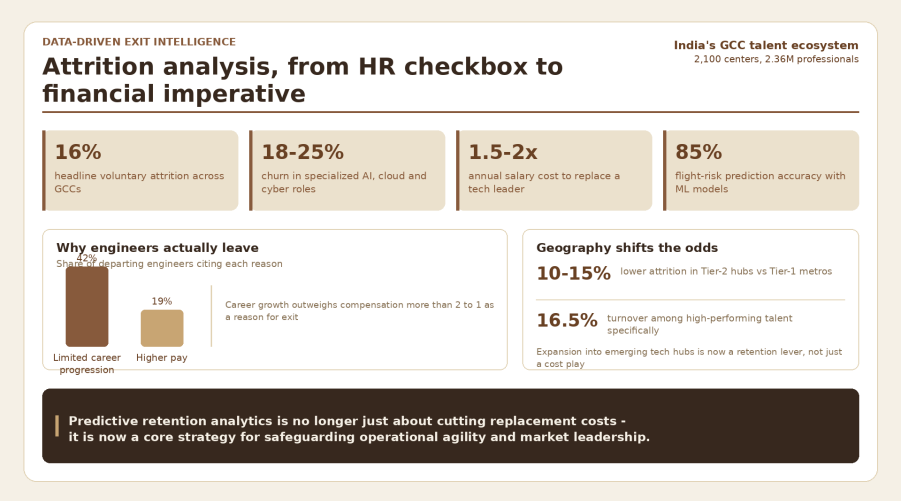
churn. Across India’s vast network of 2,100 GCCs—which collectively employ 2.36 million
professionals—headline voluntary attrition has stabilized near 16%. However, the broader
averages obscure a deeper issue: high-performing talent turnover is rising at 16.5%, while
specialized roles in AI, cloud computing, and cybersecurity experience churn rates ranging
between 18% and 25%. Given that replacing a specialized tech leader can cost up to 1.5 to 2
times their annual salary, proactive churn analysis has become a non-negotiable strategic
tool.

This analytical approach aligns seamlessly with future-of-work thinking, which treats talent
flow as a continuous barometer of organizational health. Rather than relying on traditional
exit interviews that capture grievances after an employee leaves, forward-looking talent
strategies focus on early risk detection. Industry studies show that 42% of departing
engineers leave due to limited career progression and a lack of project ownership, compared
to just 19% who leave primarily for higher pay. Addressing these underlying retention
drivers allows enterprises to fix structural flaws in workflow design and leadership culture
before talent leaves.
Modern HR innovation leverages sophisticated software platforms to turn raw workforce data
into actionable operational insights. Continuous sentiment monitoring, internal mobility
tracking, and engagement metrics give talent teams a real-time view of organizational morale.
By recognizing subtle signals—such as reduced participation in collaborative projects, delayed
task completion, or skipped learning modules—HR teams can implement personalized
retention strategies, such as offering technical upskilling opportunities or structured internal
mobility paths.
The integration of predictive AI and automation takes attrition analysis even further by
transforming reactive retention into proactive workforce planning. Advanced machine
learning models analyze complex data points—including time since last promotion, commute
friction, market salary benchmarks, and manager feedback trends—to identify flight risks
with up to 85% accuracy. Automation tools can also alert team leads to burnout patterns,
allowing managers to reallocate workloads and prevent team fatigue before it leads to
voluntary exits.
Ultimately, India’s evolving role in global enterprise strategy positions its talent ecosystem as a
proving ground for sophisticated workforce management. As multinational corporations
entrust global product ownership to regional innovation hubs, maintaining low attrition in
critical roles directly impacts business continuity. For HR startups and B2B advisors, building
advanced attrition analysis models is no longer just about reducing replacement costs—it is a
core strategy for safeguarding operational agility and market leadership.