

India’s rise as the world’s premier talent capital is undeniable, but scaling a high-performance
workforce in today’s market is far from seamless. Enterprise talent acquisition leaders and
hiring managers face a landscape marked by hyper-competition, high candidate drop-out
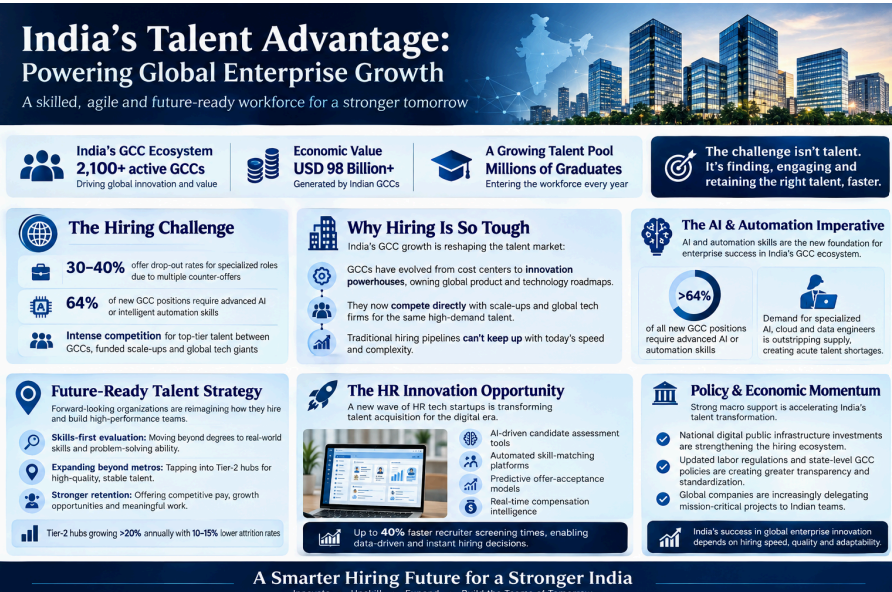
rates, and severe skill shortages. With over 2,100 active Global Capability Centers (GCCs)
generating more than USD 98 billion in economic value, the demand for specialized talent
has reached an all-time high. For fresh graduates navigating their early careers and HR
startups engineering modern recruitment platforms, solving today’s hiring bottlenecks is the
single most critical factor determining global business success.
The root of modern hiring challenges stems directly from accelerating Global Capability
Center (GCC) trends. Because GCCs have evolved from cost-saving back-office hubs into
primary innovation centers owning global software architectures and clinical product
pipelines, they are competing directly with funded scale-ups and global tech giants for the
same top-tier talent. This intense market overlap has severely impacted traditional talent
pipelines. With specialized engineering roles facing offer drop-out rates as high as 30% to
40% due to multiple counter-offers, standard hiring workflows are struggling to deliver
predictability or candidate commitment.
This talent crunch is most aggressive across AI and automation implementations. While
millions of students enter the labor market annually, the demand for specialized engineers
skilled in generative AI, cloud security, and real-time data engineering far outstrips immediate
supply. Industry data indicates that over 64% of all new GCC positions explicitly require
advanced AI or intelligent automation skills, leading to acute shortages for specialized
roles. When specialized positions remain open for extended periods, execution slows and
operational delivery risks mount across global business operations.
To combat high metro attrition, companies are actively expanding into emerging tech corridors. Headcount
growth in Tier-2 hubs like Coimbatore, Jaipur, Kochi, and Ahmedabad is expanding at over
20% annually, allowing enterprises to tap into stable, highly motivated talent pools while
benefiting from 10% to 15% lower attrition rates.
High-growth HR tech startups that
build AI-driven candidate assessment tools, automated skill-matching platforms, predictive
offer-acceptance models, and real-time compensation intelligence dashboards are seeing
rapid enterprise adoption. By reducing recruiter screening times by up to 40%, these modern
tools enable hiring teams to make faster, data-driven offers.
Decisive policy and economic signals further underline the necessity of transforming
recruitment infrastructure. National digital public infrastructure investments, updated labor
regulations, and state-level GCC policies are creating a more transparent, standardized hiring
ecosystem.
As global headquarters continue delegating mission-critical projects to Indian
technology teams, India’s evolving role in global enterprise strategy depends directly on
hiring speed and quality. By leveraging innovative recruitment technology, adopting skill-first
evaluation frameworks, and expanding into new regional talent hubs, organizations can
overcome modern hiring friction and secure the high-performing teams needed to power
long-term growth.