

While cost efficiency was once the
primary geographic driver, today’s location choices are governed by talent density, domain
specialization, and operational resilience. With India hosting over 1,800 active GCCs generating
more than USD 64 billion in revenue and employing over 2 million professionals, comparing
top Indian cities reveals how each region contributes uniquely to India’s evolving role in global
enterprise strategy. For graduates choosing their career base and HR startups building
workforce solutions, understanding these regional dynamics is paramount.
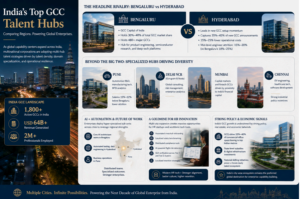
The headline story in current GCC trends is the dynamic rivalry between Bengaluru and
Hyderabad. Bengaluru remains the undisputed GCC capital of India, commanding nearly 30%
to 40% of the total GCC market share and hosting over 480 major centers. However, Hyderabad currently leads in new setup momentum, capturing
between 35% and 45% of all new GCC announcements. Driven by massive infrastructure
investments in HITEC City and the Financial District, Hyderabad offers 15% to 25% lower
operational costs and mid-level engineer attrition rates of 15% to 20%, compared to
Bengaluru’s 18% to 25%.

Pune has emerged as a premier hub for automotive R&D, manufacturing
technology, and BFSI analytics, offering salaries roughly 15% to 22% below Bengaluru
benchmarks and lower employee turnover. Delhi NCR (Gurugram and Noida) dominates in
global consulting, risk management, and enterprise analytics, while Mumbai leads in capital
markets and financial technology GCCs due to its proximity to India’s financial capital.
Meanwhile, Chennai is rapidly establishing itself in EV engineering, healthcare tech, and
software development, backed by robust industrial policy incentives.
This geographic dispersion directly influences AI + automation integration and future-of-work
thinking. Global enterprises are no longer building uniform teams across locations; instead,
they deploy hyper-specialized sub-units. For instance, a firm might run its core AI architecture
team out of Bengaluru while hosting its automated testing, data engineering, and business
operations in Hyderabad or Pune. This distributed approach forces a complete rethink of
modern talent strategy, encouraging companies to leverage regional strengths rather than
competing for the same talent pool in a single saturated metro.
This multi-city expansion creates massive opportunities for HR innovation, serving as a fertile
playground for HR startups and workforce tech tools. Managing talent across multiple cities
requires automated cross-hub onboarding, localized salary benchmarking, distributed
compliance tools, and AI-powered flight-risk detectors. HR startups that enable seamless
remote-first collaboration, skill verification across Tier-1 and Tier-2 clusters, and localized
retention strategies are experiencing rapid enterprise adoption. Modern HR tech is
transforming how multinational companies align regional compensation and workplace culture