

Supply chains have always been about getting the right thing, to the right place, at the right time,
at the right cost. For decades, global enterprises applied that logic to physical goods —
optimising the flow of components, materials, and finished products across borders with
extraordinary precision. What is happening now is that the same logic is being applied to talent,
and India is emerging as the most critical node in the global talent supply chain in a way that has
profound implications for every enterprise, every HR leader, and every startup building workforce
tools for the decade ahead.
The parallel between physical and talent supply chains is more than a metaphor. Physical supply
chains were disrupted when the world discovered, through a series of crises, that concentrating
critical production in a single geography created fragility. The response was diversification,
nearshoring, and the deliberate building of redundant capacity. The global talent supply chain is
undergoing a similar reckoning.

Developed economies that assumed they could meet their own skilled labour needs through
domestic education and immigration are discovering that the arithmetic does not work — the
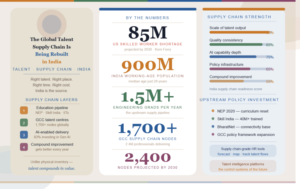
United States alone faces a projected shortage of 85 million skilled workers by 2030
according to Korn Ferry research. The response is exactly what you would expect from supply
chain thinking — find a reliable, high-quality, scalable source and build deep, long-term
procurement relationships with it.
India has the scale, the quality consistency, and the cost structure that a global talent supply
chain requires. The GCC model is the mechanism through which enterprises are formalising their
procurement relationship with India’s talent market — building captive capability centres that
give them secure, controlled access to talent flows rather than competing in an open market for
whatever is available. India currently hosts over 1,700 GCCs employing 2.4 million professionals,
and the growth trajectory toward 2,400 GCCs by 2030 represents the most significant talent
supply chain build-out in the history of global enterprise.
A talent centre in India gets better — because the professionals inside it develop deeper skills,
broader context, and stronger global relationships with every passing year. The institutional
knowledge that accumulates inside a well-managed GCC is an asset that compounds in value in
a way that physical inventory never can. This is why enterprises that built GCCs in India ten or
fifteen years ago are not looking for alternatives — they are doubling down, expanding
headcount, broadening mandates, and investing more heavily than ever in the talent
infrastructure they have built
The narrative that AI would reduce demand for Indian talent has been
comprehensively disproven. Building, training, governing, and evolving AI systems at enterprise
scale requires enormous human expertise — and India’s STEM talent pool is uniquely positioned
to supply that expertise. Over 83 percent of India-based GCCs are investing in Generative AI,
which means the talent supply chain is not just about human labour. It is about the human
intelligence that designs, directs, and improves the AI systems that will run significant portions of
the global economy for decades to come.
For HR startups and talent innovators, the talent supply chain framing is the most commercially
clarifying lens available for understanding the GCC market. Enterprises building global talent
supply chains in India need supply chain-grade workforce intelligence — tools that can
forecast talent availability, model capability development trajectories, identify emerging skill
clusters before they become mainstream, and give HR leaders the same visibility into their talent
supply chain that operations leaders have into their physical one.