

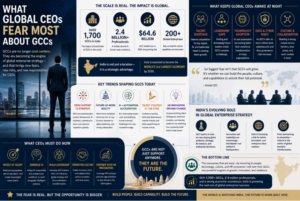
India has emerged as the world’s leading GCC destination, hosting over 1,700 GCCs that employ
approximately 2.4 million professionals. Every year, global organisations continue expanding
their India operations because the country offers a combination of technical expertise, innovation
capability, and business scalability that few markets can match. However, this rapid expansion
has intensified competition for highly skilled professionals.
CEOs recognise that success now depends on building highly connected teams that collaborate
across time zones, cultures, and business functions. While technology enables this collaboration,
organisations still depend on strong leadership, communication, and adaptability. Companies that
fail to develop these human capabilities risk losing both productivity and innovation in an
increasingly competitive environment.

AI is helping organisations automate repetitive processes, improve decision-making, strengthen
cybersecurity, and accelerate software development. However, many CEOs are concerned that
technology adoption is happening faster than workforce transformation. Implementing AI tools is
relatively easy compared to preparing employees with the skills needed to work alongside
intelligent systems. This has shifted the focus from replacing jobs to reskilling people. Businesses
now need professionals who can combine technical expertise with creativity, critical thinking, and
strategic decision-making—skills that remain difficult to automate.
Organisations must invest in continuous learning,
leadership development, internal career mobility, and skills-based hiring to remain competitive.
CEOs increasingly recognise that the companies with the strongest talent pipelines will
outperform those relying only on technology investments. Developing future leaders inside GCCs
has become just as important as investing in new digital platforms.
As enterprises
compete for specialised talent, they require smarter hiring solutions, AI-powered recruitment
platforms, workforce analytics, employee engagement technologies, and learning ecosystems
that support continuous skill development. HR innovation is moving beyond recruitment into
predictive talent intelligence, workforce planning, leadership assessment, and employee
experience management. Startups that help enterprises identify future-ready talent and build
resilient workforces will play a critical role in the continued growth of the GCC ecosystem.
GCC
leaders based in India are increasingly participating in global boardroom discussions, leading
international product teams, driving AI research, and shaping enterprise-wide business decisions.
This represents a significant shift from the early days of outsourcing, where strategic decisions
were concentrated entirely at overseas headquarters. Today, innovation, leadership, and
enterprise value creation are becoming increasingly distributed, with India playing a central role in
that transformation.
The greatest concern for global CEOs is not whether GCCs will become more important—that
question has already been answered. Their real challenge is ensuring they have the people,
leadership, technology, and organisational culture needed to unlock the full potential of these
centres. With over 1,700 GCCs, 2.4 million professionals, rapidly growing AI adoption, and strong
economic momentum, India has become one of the world’s most important strategic business
ecosystems.