

There is a concept in economics called comparative advantage — the idea that nations thrive
when they focus on what they do better than anyone else rather than trying to compete across
every dimension simultaneously. India’s comparative advantage in the global economy has always
been its people — their mathematical ability, their technical orientation, their adaptability, and
their ambition. What is changing now is the scale, the sophistication, and the global recognition of
that advantage. India is not just a source of skilled workers for the world.
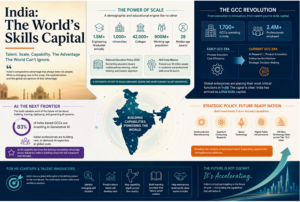
India produces over 1.5 million
engineering graduates annually, has over 1,000 universities and 42,000 colleges, and is home
to a working-age population of over 900 million people with a median age of just 28 years. These
numbers are extraordinary in isolation — but what makes them genuinely powerful is the direction
they are heading. The National Education Policy 2020 is reorienting India’s education system
toward multidisciplinary learning, critical thinking, and industry alignment.

The current era is defined by AI research,
product innovation, enterprise architecture, and strategic decision-making — functions that
were until recently considered too core to be placed outside headquarters. The fact that global
enterprises are placing these functions in India is the most powerful signal available that India has
arrived as a genuine skills capital rather than simply a talent pool.
AI and automation are the forces most likely to define India’s skills capital status over the next
decade. The global economy is undergoing a transformation in which the most valuable work is
work that involves building, training, deploying, and governing AI systems — and India is
positioning itself at the centre of that transformation. Over 83 percent of India-based GCCs are
investing in Generative AI, and the professionals doing that work are building expertise that is
genuinely scarce at a global level.
The enterprises that are building their most
important capabilities in India need sophisticated, India-aware workforce tools — platforms that
can identify emerging skill clusters, predict where talent will develop next, map capability depth
across the country, and help organisations build learning journeys that keep their people at the
frontier of global knowledge work. India’s future as a global skills capital is not a distant possibility.
It is an accelerating reality — and the organisations building the infrastructure to support it are
building at exactly the right time, in exactly the right place