

The foundation of India’s appeal for global tax functions is a talent base that combines
technical depth with regulatory literacy in a way that is genuinely unusual. India produces a
large number of Chartered Accountants, Cost Accountants, and tax law specialists annually
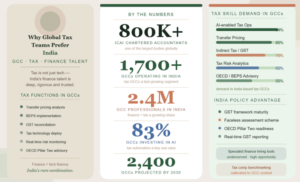
— the Institute of Chartered Accountants of India alone has over 800,000 members, making
it one of the largest accounting bodies in the world. These professionals are trained in
financial reporting standards, tax compliance frameworks, and regulatory interpretation at a
level of rigour that global enterprises have learned to trust.

The nature of tax work itself has evolved in ways that make India’s strengths increasingly
relevant. Global tax teams are no longer primarily focused on compliance filing and basic
reporting. They are managing transfer pricing analysis, BEPS implementation, GST
reconciliation across multiple jurisdictions, tax technology deployments, and real-time tax
risk monitoring. These are intellectually demanding, analytically sophisticated functions that
require professionals who can combine deep technical knowledge with strong systems
thinking.
AI and automation are reshaping the global tax function in ways that amplify India’s
advantage rather than diminishing it. Tax automation tools, AI-assisted audit preparation,
machine learning-based anomaly detection, and real-time data reconciliation platforms are
all becoming standard parts of the modern tax technology stack. The professionals who can
operate these tools effectively — understanding both the tax technical requirements and the
data engineering principles behind them — are in short supply globally.
The Goods and Services Tax framework, for all its initial complexity, has created a large
population of tax professionals with deep experience in multi-jurisdictional indirect tax
management — experience that translates directly to global tax roles. India’s participation in
international tax reform processes, including the OECD’s Pillar Two global minimum tax
framework, is creating both regulatory awareness and professional capability in areas that
global enterprises need to navigate.
For HR startups and talent strategy leaders operating in the GCC space, the global tax
function story is a reminder that the GCC opportunity extends well beyond technology roles.
The enterprises building tax GCCs in India need specialist hiring frameworks, compensation
benchmarks for finance and tax professionals, cross-functional upskilling programmes, and
succession planning tools that are calibrated to the specific demands of tax leadership roles.
The organisations that develop deep expertise in this segment — understanding what a great
global tax team in India looks like and how to build one — will find a market that is growing
steadily, relatively underserved by current HR tools, and genuinely grateful for partners who
understand their world.