

India’s talent market has always been described as a buyer’s market — a place where global
enterprises could access high-quality professionals at a fraction of what equivalent talent
would cost in the West. That description is becoming less accurate every year, and the
organisations that are still building their India strategies around the assumption of cheap,
abundant talent are going to find themselves making expensive mistakes.
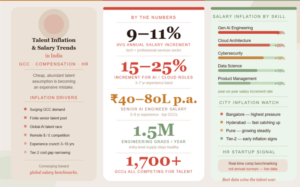
Average salary increments across India’s technology
and professional services sector have run at 9 to 11 percent annually over the past three
years — well above the global average and significantly above inflation. In high-demand
segments like AI engineering, cloud architecture, and cybersecurity, increment rates have
touched 15 to 25 percent for professionals with three to seven years of experience. These are
not one-off spikes driven by post-pandemic hiring frenzies.

A software engineer with five years of experience in AI or cloud in Bangalore is not just
competing for jobs with other Bangalore employers — they are effectively competing in a
global talent market where their skills command premium prices everywhere. India’s salary
benchmarks in these segments are converging toward global norms faster than most
enterprises anticipated.
AI and automation are the most significant contributors to salary inflation at the top of the
skills pyramid. Professionals with genuine expertise in Generative AI, large language model
fine-tuning, AI governance, and MLOps are commanding packages that would have seemed
extraordinary even two years ago. Senior AI engineers and architects in leading GCCs are
earning between ₹40 to ₹80 lakhs per annum at the five-to-eight year experience level, with
total compensation packages including equity pushing significantly higher
Bangalore has
traditionally been the most expensive talent market in India, but Hyderabad and Pune are
now seeing comparable inflation rates in technology roles as GCC activity expands in those
cities. More interesting is the early-stage inflation beginning to appear in Tier-2 cities like
Coimbatore, Jaipur, and Kochi as GCC investment moves beyond the established metros.
For HR startups and compensation intelligence platforms, talent inflation creates both
urgency and opportunity. GCC leaders need real-time salary benchmarking tools,
experience-band-specific compensation analytics, and predictive models that can forecast
where salary pressure will emerge next — not annual surveys that are outdated by the time
they are published. The enterprises managing talent inflation most effectively are the ones
with the best compensation data, the most sophisticated total rewards architecture, and the
clearest view of where their pay gaps are before their competitors identify them and exploit
them.