

Over the past decade, Global Capability Centres (GCCs) have evolved from support functions
into strategic business hubs. Today, they drive innovation, product development,
cybersecurity, data analytics, artificial intelligence, and enterprise transformation for some of
the world’s largest organisations. India sits at the centre of this shift, hosting more than 1,700
GCCs that employ approximately 2.4 million professionals, with forecasts suggesting the
ecosystem could grow to 2,400 GCCs by 2030.
Talent risk remains one of the most significant concerns for global boards. The competition
for skilled professionals in areas such as artificial intelligence, cloud computing,
cybersecurity, data science, and digital product management continues to intensify. While
India benefits from a large workforce and produces over 1.5 million engineering graduates
annually, demand for high-impact talent is growing faster than supply in many specialised
domains. This means organisations can no longer rely solely on hiring strategies.

Hybrid work models, distributed teams, and cross-border collaboration have expanded access to talent
but have also introduced challenges related to productivity, employee engagement, culture,
and workforce planning. Global boards increasingly recognise that workforce flexibility is not
simply an HR initiative. It is a business continuity strategy. Organisations that successfully
balance flexibility with performance will have a significant advantage in attracting and
retaining top talent.
Artificial intelligence and automation present both opportunity and risk. More than 80
percent of India-based GCCs are actively investing in AI-related initiatives, reflecting the
growing importance of intelligent technologies across industries. However, boards must
assess risks associated with AI governance, ethical decision-making, data privacy, model
reliability, and regulatory compliance. As AI becomes embedded within core business
processes, strong oversight frameworks will be just as important as technical capabilities.
Modern workforce analytics platforms, predictive retention models, AI-powered recruitment
systems, and skills intelligence solutions are helping organisations identify potential
workforce challenges before they become business problems. For HR startups, this
represents a major opportunity. The ability to transform workforce data into strategic insight is becoming
a competitive differentiator.
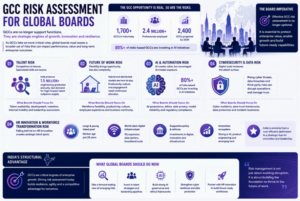
India’s role in global enterprise strategy continues to expand. The country is no longer viewed
primarily as a location for cost optimisation. Increasingly, it is becoming a centre for
innovation, AI research, product engineering, cybersecurity leadership, and strategic
decision-making. This shift changes how boards think about risk. Protecting a GCC today is
not simply about protecting an operational centre. It is about protecting a critical engine of
enterprise growth and competitive advantage.
For global boards, effective GCC risk assessment requires a forward-looking mindset. The
most successful organisations will be those that view talent strategy, workforce innovation, AI
governance, and long-term capability building as interconnected priorities. As GCCs continue
to move closer to the centre of enterprise strategy, risk management will no longer be about
avoiding disruption alone. It will be about creating the resilience, agility, and talent
foundations needed to thrive in the future of work.