

India has quietly built one of the most advanced digital ecosystems in the world. What makes
it remarkable is not just its scale, but its ability to create efficiency, accessibility, and
innovation across industries. For Global Capability Centres (GCCs), HR technology
companies, and workforce innovators, India’s DPI is becoming a strategic advantage that
strengthens the country’s position in global enterprise strategy.
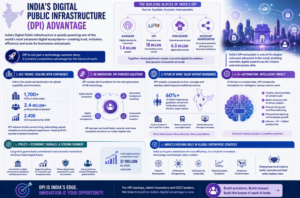
At the heart of India’s DPI ecosystem are platforms such as Aadhaar, UPI, DigiLocker, and
Account Aggregator. Together, these systems enable secure digital identity, seamless
payments, digital document verification, and consent-based data sharing at a national scale.
Today, Aadhaar covers more than 1.4 billion people, while UPI processes over 18 billion
transactions every month, making it one of the largest digital payment networks in the world.

The impact on GCC growth is significant. India currently hosts over 1,700 GCCs employing
approximately 2.4 million professionals, with projections suggesting the number could reach
2,400 GCCs by 2030. As enterprises expand their operations in India, digital infrastructure
reduces friction across hiring, onboarding, payroll, compliance, and employee experience.
Tasks that once required extensive paperwork and manual verification can now be completed
digitally within minutes.
Companies need faster hiring cycles, better employee verification systems, more efficient
workforce management, and stronger compliance processes. India’s DPI ecosystem provides
a foundation upon which innovative HR solutions can be built. Startups that integrate digital
identity verification, automated background screening, digital credential management, and
AI-powered workforce analytics can create substantial value for enterprise clients.
Hybrid work, distributed teams, and cross-city hiring have become standard operating
models for many organisations. Digital infrastructure allows companies to recruit talent from
emerging cities rather than relying exclusively on traditional hubs such as Bangalore,
Hyderabad, Mumbai, and Delhi. This is especially important because a significant portion of
India’s engineering and professional talent comes from Tier-2 and Tier-3 cities, where access
to global employment opportunities continues to improve.
Artificial intelligence and automation further strengthen the value of DPI. AI systems rely on
large volumes of accurate, structured, and verifiable data. India’s digital ecosystem helps
create trusted digital records that can support AI-driven recruitment, workforce planning,
employee engagement, and talent development initiatives. Rather than replacing workers, AI
is increasingly augmenting human capabilities, creating demand for professionals who can
build, manage, govern, and optimise intelligent systems.
India’s role in global enterprise strategy is evolving rapidly. The country is no longer viewed
solely as a destination for cost-efficient operations. It is increasingly recognised as a hub for
innovation, product development, AI research, cybersecurity, and strategic decision-making.
As enterprises look to build resilient, technology-enabled operating models, India’s digital
capabilities are becoming a central part of the conversation.
For HR startups, talent innovators, and GCC leaders, the message is clear. India’s Digital
Public Infrastructure is not simply a technology success story. It is a competitive advantage
that enables faster scaling, smarter talent strategies, greater operational efficiency, and
stronger innovation outcomes. As the future of work continues to evolve, organisations that
build solutions aligned with India’s digital ecosystem will be well positioned to capture the
next wave of enterprise growth.