

The most fundamental advantage is demographic. While Europe ages, Japan contracts, and
China deals with the consequences of decades of population control, India is sitting on a
working-age population of over 900 million people with a median age of just 28 years. This is
not a temporary condition — it is a structural reality that will continue to compound for at
least another two decades. For global enterprises facing talent shortages in their home
markets, this demographic surplus is not just convenient. It is existential. The United States
alone faces a projected shortage of 85 million skilled workers by 2030, and India is the only
market on earth that can meaningfully address that gap at scale.

Education is the second pillar of India’s talent lottery win. The country produces over 1.5
million engineering graduates annually — a number that dwarfs every comparable market.
More importantly, India built a culture around technical education at a time when the global
economy was shifting toward knowledge work. The IITs, IIMs, NITs, and the broader university
system created a pipeline of technically capable, English-proficient, globally ambitious
professionals that enterprises from every sector now depend on.
English proficiency is the often-underappreciated third factor. India is the world’s largest
English-speaking workforce, and that single characteristic removes an enormous barrier to
global enterprise integration. Teams in Bangalore or Hyderabad can collaborate with
counterparts in London, New York, or Toronto with minimal linguistic friction.
Documentation, communication, client interaction, and leadership development all happen
in the same language as the global organisation — which accelerates capability building in
ways that are difficult to quantify but impossible to overstate.
Global enterprises are placing AI research, product strategy, cybersecurity leadership, and
enterprise architecture in India because they have concluded that the best place to build
these capabilities for the next twenty years is right here. Over 83 percent of India-based
GCCs are investing in Generative AI — which tells you exactly what the people writing the
largest enterprise cheques think about India’s AI talent potential.
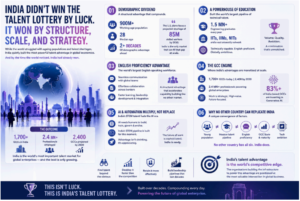
AI and automation are amplifying rather than diminishing India’s advantage. The narrative
that automation would reduce demand for Indian talent has been comprehensively
disproven. Building, training, governing, and evolving AI systems requires enormous human
expertise, and India’s STEM pipeline is uniquely positioned to supply that expertise at the
scale global enterprises need. The talent lottery win is not just holding — it is appreciating in
value as the nature of knowledge work becomes more sophisticated.
For HR startups and talent innovators, India’s structural advantage creates a clear and longterm commercial mandate. The enterprises that have won the lottery by choosing India need
partners who can help them find talent beyond the obvious, develop it faster than the
competition, retain it more effectively, and build the leadership pipelines that will sustain
their GCC operations for decades. India did not win the global talent lottery by accident.