

Something has shifted in the boardrooms of the world’s largest companies. India used to
appear in global strategy conversations as a cost-reduction lever — a place to send work that
was too expensive to do elsewhere. That conversation has fundamentally changed. Today,
when global boards discuss India, they are talking about long-term strategic positioning,
capability building, and innovation infrastructure. The shift is not subtle and it is not
temporary. It is a structural realignment in how the world’s most sophisticated enterprises
think about where their future will be built.

The numbers tell part of the story clearly. India is currently the fifth largest economy in the
world and is widely projected to become the third largest by 2030. Its working-age
population of over 900 million people is the largest in the world, and unlike many developed
economies that are ageing rapidly, India’s demographic dividend will continue to compound
for decades. For global boards thinking about where to anchor long-term operations, those
fundamentals are extraordinarily difficult to argue against.
The GCC story is the most visible expression of this long-term commitment. India currently
hosts over 1,700 Global Capability Centres employing 2.4 million professionals, and
projections point to 2,400 GCCs by 2030. What is significant about recent GCC investment
patterns is not just the volume — it is the nature of the mandates being given to India-based
teams. Global boards are not setting up centres to handle overflow work.
They are placing AI research, product strategy, risk management, and enterprise
architecture functions in India and asking those teams to lead globally. That is a
fundamentally different investment thesis from what drove the first generation of offshore
operations.
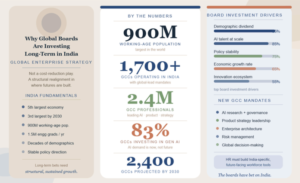
India’s deep STEM talent pool — with over 1.5 million engineering graduates produced
annually — is uniquely positioned to supply that demand at a scale that no other market can
match. Over 83% of India-based GCCs are already investing in Generative AI, which means
the AI talent demand is not a future story. It is a present one.
Policy signals from the Indian government are reinforcing global board confidence in a way
that matters enormously to long-term investors. The PLI scheme, semiconductor investment
programme, digital infrastructure buildout, and SEZ framework together create a stable,
incentive-rich environment that reduces the regulatory risk premium associated with largescale India investment.
The enterprises making these investments need workforce intelligence tools, leadership
development infrastructure, skills mapping platforms, and retention architecture that can
scale with their India operations over years and decades — not just quarters. The HR ecosystem’s job is to make sure India’s talent infrastructure is
ready to deliver on it.