

Global Capability Centers, or GCCs, are growing fast, and workforce planning has become one of their
biggest success factors. In the past, many GCCs were built as low-cost delivery centers. Today, they are
expected to drive innovation, speed, and strategic value. This shift means that hiring fast is no longer
enough. Companies need a clear, future-ready workforce plan from day one.

Modern workforce planning starts with future-of-work thinking, not just today’s roles. Many skills
being hired for now will change within a few years. Studies show that around 60–65% of job skills
will evolve by 2030, especially in technology and digital roles.
India plays a central role in this story. The country is home to over 1,900 GCCs employing nearly 1.9
million professionals, and this number continues to rise every year. Global enterprises now look at
India not just for scale, but for leadership in areas like AI, data engineering, cybersecurity, and product
design. For new GCCs, this creates both opportunity and pressure to get workforce planning right.
This is where HR innovation becomes critical. Instead of static headcount plans, leading GCCs use
dynamic workforce models. These models combine business goals, project pipelines, and skill data to
predict talent needs. For example, a new fintech GCC in Bengaluru used AI-based forecasting to plan
hiring across engineering, compliance, and analytics. This helped them reduce over-hiring and cut
ramp-up time by nearly 30%.
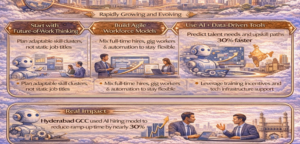
A strong talent strategy also means mixing different types of talent. New GCCs are moving beyond
full-time hiring alone. They blend permanent staff with gig workers, internal rotations, and automation.
This approach gives flexibility while keeping costs under control.
AI and automation are now built directly into workforce planning. AI tools map skills, identify gaps,
and recommend learning paths for employees. Automation takes over repetitive tasks, allowing teams
to focus on higher-value work. One global retail GCC in Hyderabad automated nearly 40% of routine
reporting tasks, freeing analysts to work on customer insights and innovation instead.
India’s evolving role in global enterprise strategy is clear. GCCs here are no longer back-end support
units. They lead global platforms, own products, and influence business decisions worldwide. This
means workforce planning must include leadership development, cross-cultural training, and global
exposure from the start.
In the end, workforce planning for new GCCs is about building teams that can grow with the business.
When done right, it reduces risk, improves speed, and turns a new GCC into a global value creator —
not just a delivery center.