
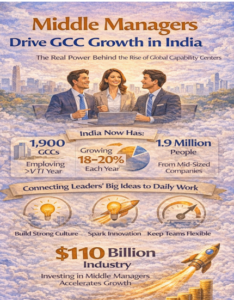
Middle managers are quietly becoming the real growth engine of India’s Global Capability Centers
(GCCs). As GCCs move beyond cost savings and focus on innovation, speed, and scale, this layer of
leadership plays a critical role in connecting strategy with execution.
In today’s GCC landscape, middle managers sit at the center of GCC trends and future-of-work
thinking. Hybrid work, global collaboration, and AI-driven projects have made work more complex.
Senior leaders define the direction, but middle managers make it real. They translate global goals into
clear tasks, manage distributed teams across time zones, and ensure outcomes are delivered.

Middle managers also play a key role in building strong culture, encouraging innovation, and keeping
teams flexible in a fast-changing environment. They help people work better together, adapt to new
tools, and stay motivated even during rapid growth.
These managers stand out because they have strong product and business understanding. They
help teams clearly connect their daily work to overall company objectives, which improves focus and
accountability. Instead of only assigning tasks, they explain how each role contributes to business
outcomes
Many high impact managers grow by rotating across roles and functions, giving them a broader view
of the business. This exposure helps them move from task execution to end-to-end ownership of
results. They take responsibility for performance, people development, and outcomes, not just day-today operations.
 .
.
GCCs that promote and rotate talent internally fill 25–30% of leadership roles from within, reducing
hiring costs and improving cultural fit. A real life example is a global technology GCC in Pune that built
a manager-led internal project marketplace. Middle managers nominated team members for short term
global projects, helping fresh graduates gain exposure while preparing future leaders.
AI and automation are also reshaping what middle managers do. Instead of tracking tasks manually,
automation now handles reporting, approvals, and routine workflows. This frees managers to focus on
coaching, innovation, and problem-solving. In AI heavy GCCs, managers who understand both
technology and people help teams move faster from ideas to execution.
Indian GCC hubs like Chennai and Bengaluru continue to lead because of such capable middle
managers. Their ability to combine technical expertise, people leadership, and cross border
collaboration makes teams stronger and more resilient. For business leaders, investing in these
managers directly improves execution, talent retention, and long-term scalability.
In simple terms, GCC growth does not scale without strong middle managers. For B2B leaders and
HR startups, this creates a clear opportunity: invest in manager enablement, AI tools, and leadership
development. When middle managers succeed, GCCs grow faster, talent stays longer, and India
strengthens its position as a global enterprise powerhouse.