

. AI is not replacing GCCs — it is making them
more important than ever. As businesses become more digital, they need centralized hubs that
can manage AI systems, govern data, and drive innovation at scale. That role fits perfectly with
the modern GCC model.

Interestingly, nano and mid-sized GCCs are leading this transformation. Because they are smaller
and more agile, they can quickly build specialized AI roles such as AI engineers, prompt designers,
and automation architects. They focus on deep expertise rather than large teams. This allows
them to move faster and experiment more.
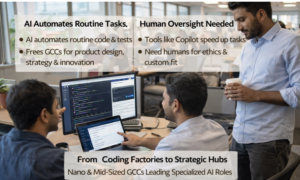
Tools like GitHub Copilot and other AI coding assistants can speed up development significantly.
They suggest code, detect errors, and even help with documentation. But these tools are not
perfect. They still need human oversight to ensure the code is secure, ethical, and customized for
specific business needs. AI can generate suggestions, but experienced engineers must review,
refine, and make final decisions.
Reports indicate that over 126,000 AI professionals now work within Fortune 500 GCCs in
India, contributing significantly to enterprise-wide digital programs. Instead of shrinking, these
centers are gaining ownership of global analytics, cybersecurity, and AI product development.
AI changes job roles, but it does not eliminate
the need for human expertise. Professionals now work alongside AI tools to make faster and
smarter decisions. Organizations that combine AI systems with human judgment see
productivity gains of up to 30%. This hybrid model requires structured teams, governance
frameworks, and continuous training all strengths of a mature GCC.
Companies are investing in skills such as machine learning,
prompt engineering, AI ethics, data governance, and cloud architecture. India’s AI workforce is
expected to grow by 55% by 2026, reaching around 2.35 million professionals. This growth
demands advanced hiring platforms, skill-mapping tools, and reskilling programs.
This is changing how GCCs are viewed globally. Earlier, some people saw them mainly as “coding
factories” focused on execution. Now, they are evolving into strategic hubs that contribute to
product thinking and global technology roadmaps. Instead of just delivering tasks, they are
shaping solutions.
AI does not eliminate GCCs. It strengthens their purpose. In a world driven by automation,
structured centers of expertise become essential. That is why AI does not replace GCCs it
makes them inevitable.