

Global Capability Centers, widely known as GCCs, have evolved from back-office support
units into strategic engines for global enterprises. Today, there are 1,900+ GCCs in India
employing over 2 million professionals, and their mandate is expanding beyond cost
efficiency to innovation, digital transformation, and enterprise leadership. As artificial
intelligence and automation mature, many GCCs are now exploring what happens when they
automate up to 40% of repetitive work.

When 40% of repetitive tasks such as data processing, report generation, ticket resolution,
compliance checks, and routine finance operations are automated, the immediate impact is
productivity. Studies consistently show that automation can improve operational efficiency
by 20–30% and reduce process costs by 15–25%.
An operations manager will oversee automated workflows. The emphasis moves from “doing
tasks” to “managing outcomes.” In this model, AI becomes a co-pilot, not a replacement. This
transformation places HR innovation at the center of GCC strategy. If nearly half of repetitive
work is automated, workforce planning must be redesigned. HR teams need to focus on
reskilling and redeployment rather than replacement.
Today, capability is the differentiator. Organizations that
invest in AI training across 60–70% of their workforce will build stronger resilience. Instead
of hiring thousands for repetitive roles, companies will hire fewer but more skilled
professionals who can manage automation systems, interpret data, and drive innovation. This
creates a more agile, future-ready workforce aligned with global enterprise expectations.
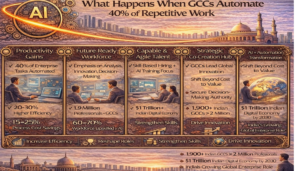
From a global enterprise strategy perspective, automating 40% of repetitive work changes
how headquarters view their GCCs. They are no longer cost arbitrage centers but strategic
co-creation hubs. Decision-making authority gradually shifts to these centers as they
demonstrate higher productivity and innovation output.
Governance frameworks,
data privacy safeguards, and ethical AI standards must evolve alongside automation.
Enterprises that combine efficiency with compliance and transparency will build stronger
global trust. HR leaders play a key role in shaping this balance by ensuring clear
communication, fair transition planning, and inclusive skill development programs.
So what really happens when GCCs automate 40% of repetitive work? Costs reduce.
Productivity rises. Roles evolve.Talent strategy becomes smarter.
HR becomes morestrategic. India strengthens its position in global enterprise networks. Most importantly, work
becomes more meaningful. The focus shifts from execution to innovation.
Automation is not just a technology upgrade; it is a workforce redesign. GCCs that combine
AI + automation with strong talent strategies and forward-looking HR innovation will define
the next decade of global business from India.